
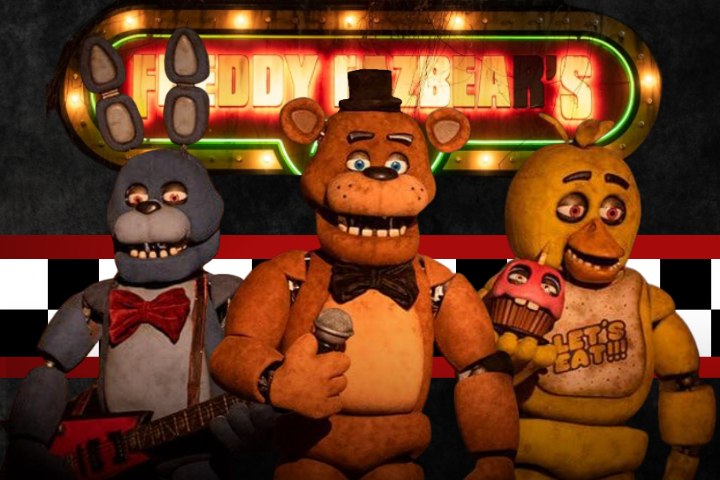
(Left to right) Bonnie The Bunny, Freddy Fazbear, Mr. Cupcake and Chica The Chicken from “Five Nights at Freddy’s” (2023)
Graphic by Dani Ramirez
By Morgan McMurray
Those already familiar with the “Five Nights at Freddy’s” (FNAF) video games and story may enjoy the movie adaptation’s fan service and true-to-source, immersive experience on the big screen. Cinephiles and horror enthusiasts, however, will likely find the movie’s tone shifts confusing and its resolution lackluster. Reader beware: this review contains massive spoilers for the plot of “Five Nights at Freddy’s” (2023).
Synopsis
Set within the midwestern United States during the year 2000, the FNAF movie follows Mike Schmidt (Josh Hutcherson) and his little sister, Abby (Piper Rubio), while they navigate Schmidt’s new job as the security guard for the abandoned Freddy Fazbear’s Pizza Place. With the help of Officer Vanessa Shelly (Elizabeth Lail), Schmidt — a young man traumatized by the kidnapping of his late brother, Garrett (Lucas Grant) — learns the story of Fazbear’s closure and how it connects to his brother’s disappearance. Schmidt’s revelation leads him to finally confront the instigator of both tragedies: William Afton (Matthew Lilard). FNAF fans will likely recognize the plot — it is clearly inspired by the storylines of the first game and novel, with faithful set recreation and animatronic styling to match.
Fan Service Shines Through
The FNAF movie was clearly designed with its fanbase in mind. The opening credits reference the Atari-style minigames from the FNAF game series. MatPat, the former host of Game Theory, a YouTube channel which became popular for its video essays on the FNAF franchise’s hidden storylines, makes a cameo about half an hour into the film. The Living Tombstone’s iconic “Five Nights at Freddy’s” song is also the first track that plays during the end credits. In fact, Scott Cawthon, the FNAF franchise’s creator, helped produce and write the film. It makes sense, then, that the movie aligns with and overtly references the FNAF video games and fandom. Additionally, director Emma Tammi, in an interview with Inverse, stressed that striving for a PG-13 rating was important “because there’s such a younger audience for FNAF, and we didn’t want to exclude them,” further indicating a dedicated effort in making the FNAF movie for the FNAF community.
As a longtime casual fan of the FNAF series, and as someone who regularly engaged in its fan culture when I was younger, I was excited to see the references to source and fan material on the big screen. Had the movie been released closer to my introduction to the original video games and storyline, fourteen-year-old me would have also appreciated the rating-conscious cinematography choices: gory scenes told through shadows, bloody handprints as opposed to bloody bodies and an emphasis on sound design and close-up action shots as opposed to graphic jump scares.
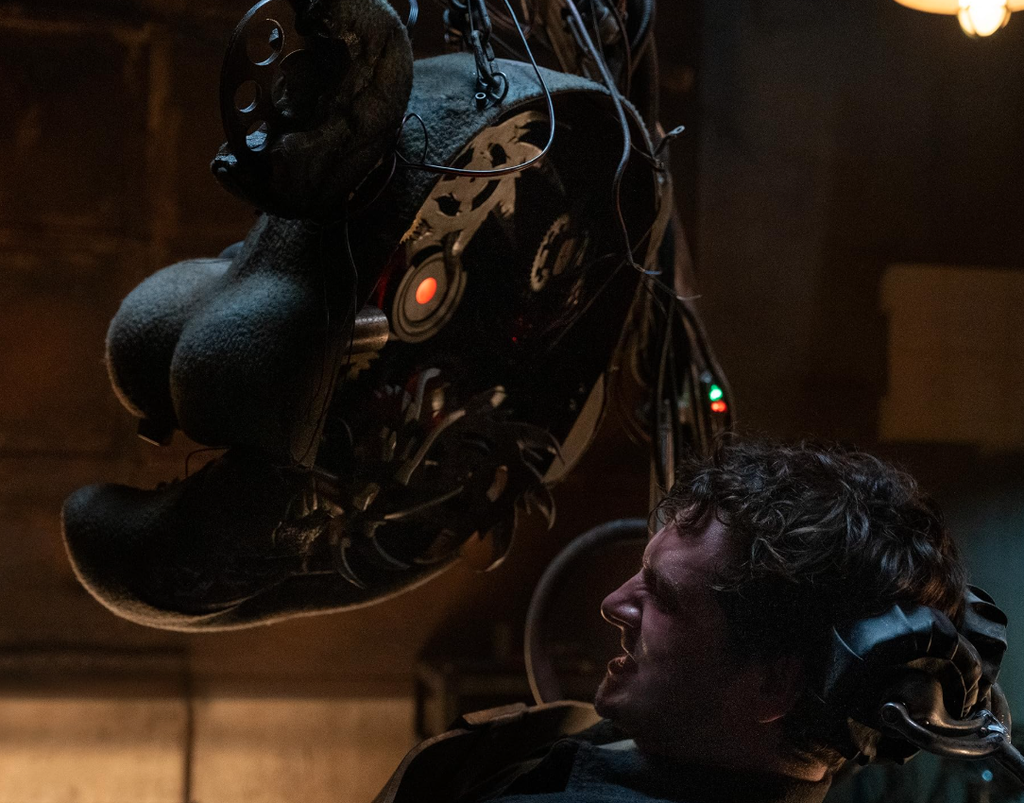
Mike Schmidt (Josh Hutcherson) struggles against animatronic bear head trap
(“Five Nights at Freddy’s” / © Universal Studios)
FNAF Makes a Strong First Impression
Speaking of cinematography, the FNAF movie starts with a strong hook: an anxious security guard tries to remove the grate off an air vent so he can escape a murderous… something… making a ruckus behind him. His escape is ultimately unsuccessful and he ends up strapped to a chair while a bear mask with rotating blades lowers over his face. This first scene expertly combines a dark color palette, scary sound design and close-up shots to create fear and suspense. The very first sound is the squeaking hex bolt holding the vent’s grate together, followed closely by the guard’s rapid breathing and high whimpering before the viewer sees dimly lit, sweaty fingers turning the hex bolt, cutting straight to a close-up profile of the guard’s sweaty face as he desperately tries to open the vent. The blues, grays and blacks of the security guard’s uniform and his surroundings emphasize how grim his situation is. The hard cuts between different angles of the security guard as he tries to escape further add to the viewer’s sense of unease. The loud crashes combined with lingering, eerie synthesizer pads pull the scene together: the security guard on screen is in danger and likely will not survive. Safe to say, I was terrified — and thoroughly impressed.
But the Movie Fails to Sustain a Horror Feel
I expected this quality would remain throughout the rest of the film. Sometimes, those expectations were met, like in the scene where Jeff (David Lind) and his group of “guys” trash Freddy Fazbear’s Pizza. The jump cuts between Jeff’s group and the security cameras’ views of the animatronics coming to life foster tension through dramatic irony. The ominous synthesizer tones alongside Jeff’s crew destroying the pizzeria warn the viewer of these characters’ impending doom. All of this culminates into jump scares of the animatronics and a final chase that leads to the satisfying deaths of those who dared mess with Freddy Fazbear’s Pizza.
As the movie continued, however, it seemed like maintaining a horror feel was not its main priority. About an hour in, there was an upbeat montage of Schmidt, Abby, Shelley and the animatronics building a blanket fort in the abandoned pizzeria. Here it felt like the film wanted to be a feel-good children’s movie more than a horror story, which confused me as a viewer. But what disappointed me most was the climax. The choice to make Abby draw a picture of Afton murdering the children possessing the animatronics — so that they would turn on him — felt like a cheap cop-out compared to how the scene was set up: jump cuts between Schmidt realizing with alarm that Abby is missing and Abby slowly finding out that her “friend” Chica does not have good intentions for her. The animatronics closing in on Afton as his spring-lock suit suddenly and miraculously fails right after Abby finishes the picture also seemed like a rushed reach for a happy ending.
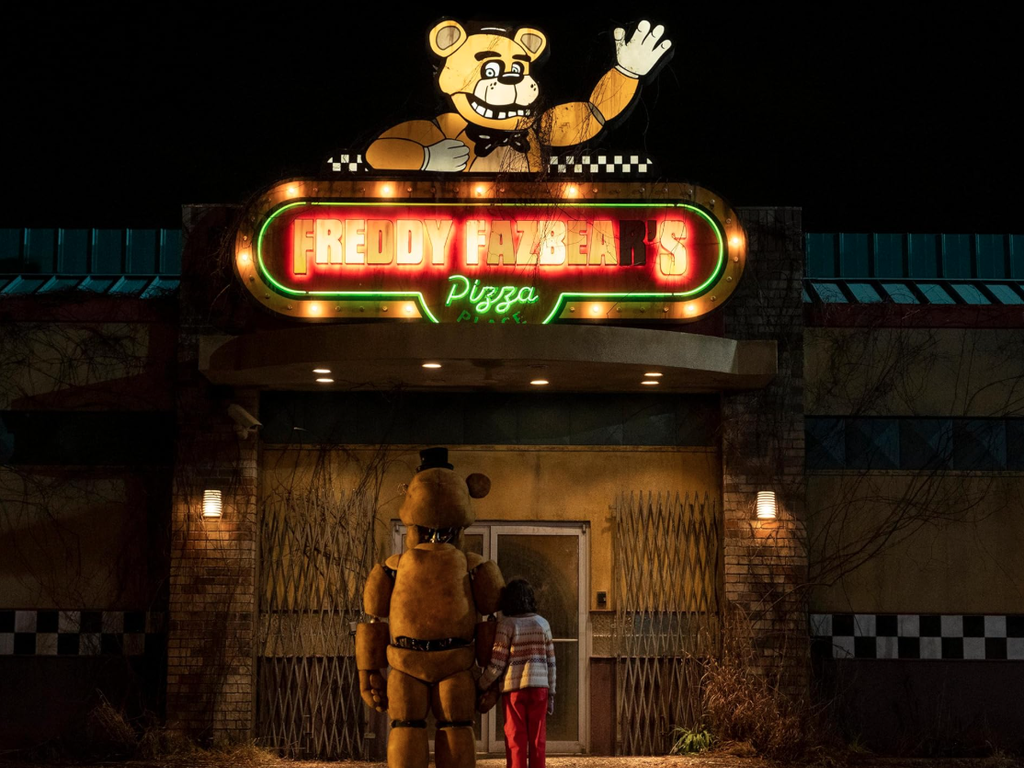
Freddy Fazbear and Abby (Piper Rubio) outside of Freddy Fazbear’s Pizza Place
Photo by Patti Perret
(“Five Night’s at Freddy’s” / © Universal Studios)
Good horror, in my opinion, leaves the viewer with a sense of unease long after the story is finished. Typically, this is because the characters experienced a costly, fundamental change or revelation. In the first FNAF game, there was a sense of uneasy, ironic, almost futile celebration at the end of each night, which was a key part of its horror storytelling. Each night ends with the on-screen digital clock visually transitioning from 5:00 a.m. to 6:00 a.m. as the Westminster Quarters melody plays and concludes with a cheesy soundtrack of cheering children. This “reward” seems pitiful in comparison to the effort it takes to cycle through camera views, light adjustments and door closures under a limited power supply, leaving the player with a sense of dread as they realize they must repeat this process under increasingly urgent conditions. Unlike the first FNAF game, the FNAF movie failed to capture and retain the lingering sense of unease characteristic of good horror, which made the
film unsatisfying.
Make no mistake, the core concept behind the FNAF franchise is a compelling horror story: animatronics possessed by the souls of murdered children attempt to enact brutal revenge on an innocent security guard. It makes sense that a loyal, engaged fanbase grew from this narrative in the original FNAF games. Considering that quality horror storytelling and mechanics were what made the games popular, it is truly unfortunate that I as a viewer felt that the FNAF movie did not deliver a similarly effective horror experience. Although I liked the references as a longtime fan, I was more disappointed by the plot’s confusing tone shifts and lackluster resolution. Surely, there was a way for the movie to honor existing fans while adhering to storytelling strategies that make great horror.
