
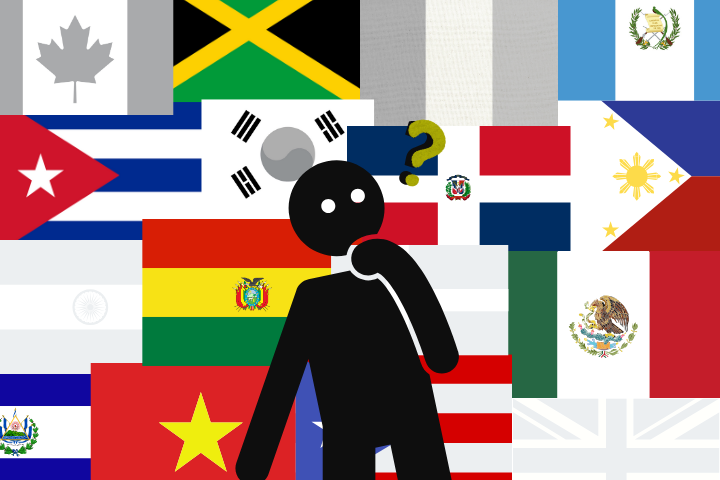
Graphic by Dani Ramirez
Written by Timothy Walker
I was walking on campus the other day when an unoriginal thought came to me:
“Why does the Cultural Center primarily reflect Black and Latinx students?”
Yes, there is Inclusive Student Services, but it operates as an umbrella for five groups.
So I put on my journalist badge and started scheduling meetings.
I spoke with students who felt excluded, including leaders of Kilusan Pilipino (KP), the Native American and Indigenous Student Association (NAISA), the Indian Student Association (ISA) and the Vietnamese Student Association (VSA). Along with them, I spoke with staff who offered much-needed insight. What I learned shows a more complicated picture than simple exclusion.
The campus is not trying to leave anyone out. In fact, it is the opposite. But representation for Asian, Pacific Islander and Native American students has not gained traction until the past two years. Before this, Black and Latinx student centers were emphasized to provide support for identity and academic growth.
The Division of Student Affairs annual report for the 2024-25 academic year lists as a priority the goal to “continue to evolve our academic support services in the Black & Latinx Cultural Centers to continue retention support efforts for students.” Earlier reports cite “Social Justice, Equity and Inclusion outcomes” as drivers for these decisions.
That raises a fair question: What about students outside those categories?
Judy Kim, an English major, senior and Inclusive Student Services Asian American Pacific Islander intern, said the Cultural Center “is still in its toddler stage of development,” which leaves room for growth. In the past two years, ISS has brought API representation under its wing — alongside four other groups it already serves. ISS itself stands apart from the Latinx and Black cultural spaces, but the gaps are visible.
Omkar Pati, a biology major, senior and president of the Indian Student Association, acknowledged the support ISS provides, saying, “They give us a lot… and it is fantastic! But we are still grouped as Asians.” His vice president, Bhakti Chalke, a biotechnology major and senior, added, “As an international student, the Indian student life was completely non-existent.” Their club has become a pulse for students who once felt invisible.
Leah Lai, a biology major and vice president of the Vietnamese Student Association, said “it takes a lot of effort from API” to coordinate events and that “bringing us together is needed because of how low density we are.” Her first year, she said, there was little to no representation until she, Judy Kim and Minda Tran began organizing VSA.
Hannah Ann Nicole Binuluan, a health science major, senior and president of Kilusan Pilipino, agreed: “Before when I joined, there was not very much celebration for us.” Leadership gave her the community she had been missing — even if it took until her fourth year.
Sylvia Tumamait, a sociology major, senior and president of the Native American and Indigenous Student Association, spoke candidly. As a member of the Chumash, she did not feel represented despite ISS efforts. “If I did not sign up, the school would kill the club,” she said. Representation, for her, is conditional — dependent on student advocacy.
All of this raises 2 questions of weight: How much burden should students carry to represent their communities? And how much can lack of support quietly erase belonging?
Another primary barrier is resources. “I wish we had an API center,” said Tran, a liberal studies major, sophomore and VSA president. “But I do not know how realistic that is. There just is not enough funding and space.”
This sentiment came up again and again.
Simona Sargizian, a psychology major, senior and Assyrian resident, said with more resources the school should bring in diverse educators. “The school should bring in historians to better inform and educate our community on minorities and their struggles. It is important to find people you connect with on a cultural level to feel like you are included.”
There are practical ideas, too. Pati suggested a mentorship program for international students, since “we are a single dot and get overlooked by bigger groups.”
So what is there to hope for?
Underrepresented groups want spaces that reflect them. While administrative support is growing, students still carry much of the responsibility to create and maintain community. A future cultural center that reflects the full demographics of the student body — a place to connect, find resources and build networks — feels like the natural next step.
In the meantime, each of these clubs is open to others joining, even those who do not directly identify. These leaders know what it is like to walk campus unseen and choose to make change anyway.
When I asked what students who feel unrepresented should do, every leader pointed to the same answer: co-construct community. You do not need to “fit” neatly into a category to join.
So to those who go unseen: know that you are not alone. These clubs welcome you.
And if you think you can start a club, do it. Someone will help. Every step of involvement strengthens the campus’s ability to grow. And that is how real change starts.
