
Photo by Timothy Walker
Written by Timothy Walker
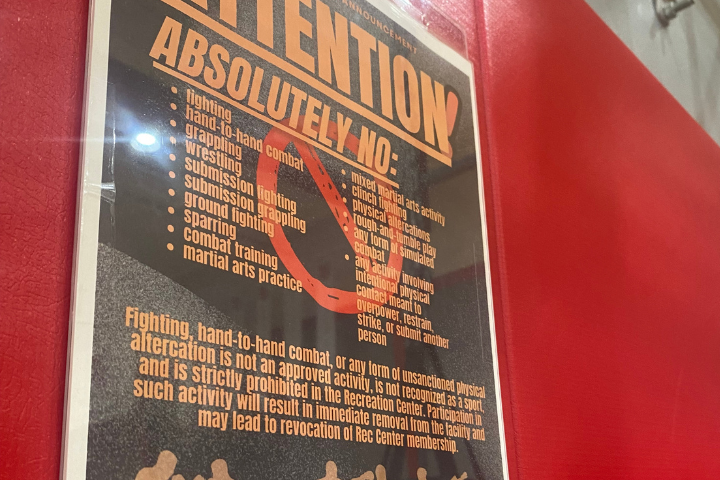
The @csuci_rec Instagram account released a post on Feb. 5 announcing that “absolutely no fighting, hand-to-hand combat, grappling, wrestling, sparring or any form of martial arts practice” is allowed inside the Recreation Center.
The comment section was filled with negative feedback. User @dirty_kills sarcastically called out the rec for removing “a safe space for students practicing a highly beneficial practice in a safe environment.” Other users responded by expressing gratitude for their own campuses offering the sport, criticizing the decision and even the Brazilian Jiu-Jitsu UCLA account @uclabjj commented, “Bring BJJ to CSUCI.”
As of the time of writing, the post has received 144 shares and 24 comments. Compared to the Recreation Center’s pinned post, which has 16 shares and nine comments, the difference suggests the announcement resonated beyond the small number of students who regularly use the facility’s amenities.
Jett Marquez-Lawley, coordinator of Campus Recreation Programs, said the Recreation Center has been and still is willing to work with students interested in forming a martial arts club. Marquez-Lawley explained that several students have previously expressed interest in starting such an organization but failed to complete the procedural steps required to legitimize the club through the University.
Marquez-Lawley also noted that one of the largest barriers is insurance and liability. While the Recreation Center can assume responsibility for its equipment, that responsibility changes when equipment is used in direct physical contact between students. If a club were established, members would also need to provide funding for equipment, sanitation and storage.
According to Marquez-Lawley, the Recreation Center remains open to working with students to create an organized space for martial arts practice. However, under current policies and insurance restrictions, the center cannot permit unsanctioned combat sports activities within the facility.
Selene Kelsey, a senior anthropology major who works at the Recreation Center, said she first noticed students practicing martial arts informally last semester. According to Kelsey, groups of three to five students would gather in a corner of the gym to train.
She also emphasized that Campus Recreation staff are aware of the interest but must balance student demand with safety and liability concerns.
“We are definitely aware students are interested,” Kelsey said. “But we need more engagement before going all in. We have to make sure it’s safe and liable for both parties. I know that the Rec is aware.”
Kelsey pointed out that the Recreation Center has already taken small steps toward supporting combat-style training, such as installing a punching bag in the gym.
“Students were interested, so we brought the punching bag in,” she said. “As long as students voice their interest in martial arts, we can work something out.”
Kayla Hernandez, a junior English major and Recreation Center employee, said she noticed a similar shift once the punching bag was introduced.
“The minute we got the punching bag, I noticed people were training a lot more,” Hernandez said.
To better understand student interest in martial arts on campus, a small survey of CI students was conducted by The CI View. Of the nine respondents, 88.9% identified as current CI students. The responses also showed that interest in martial arts extends beyond beginners. About one third of respondents reported training for more than three years, while the remaining responses were evenly split between those with less than six months, six months to one year and one to three years of experience.
Training frequency varied, though many respondents reported consistent practice habits. Over half said they train occasionally, while others reported training once per week or several times per week.
Interest in an official martial arts club was overwhelmingly positive. When asked whether they would join a martial arts club if CI offered one, 88.9% of respondents answered yes, with the remaining respondents selecting maybe. None of the respondents said they would not join.
Students also cited a variety of motivations for practicing martial arts. Responses included stress relief, physical fitness, self-defense, and emotional stability. One respondent described training as being motivated by “the love of the art and the desire to get better with discipline,” while another said martial arts helps them “maintain a healthy weight, relieve stress and develop combat skills for protection.”
Over the past several months, small groups of students had begun meeting inside the Recreation Center to practice martial arts fundamentals. The group was informal and typically consisted of three to six students at a time, often working on drilling techniques or practicing combinations on the heavy bag.
When the Recreation Center clarified its policy prohibiting martial arts training involving physical contact, those sessions effectively came to an end.
Many university recreation centers across the country prohibit contact combat sports unless they are organized through an officially recognized club structure with waivers, supervision and insurance coverage. In that context, CI’s policy reflects a common administrative approach to managing risk in recreational facilities.
The situation leaves a clear question for both students and administrators moving forward: whether interest in martial arts on campus will eventually translate into the formation of a sanctioned club, or whether students interested in the sport will continue to look for affordable training opportunities off campus.
