
By Kevin Fox
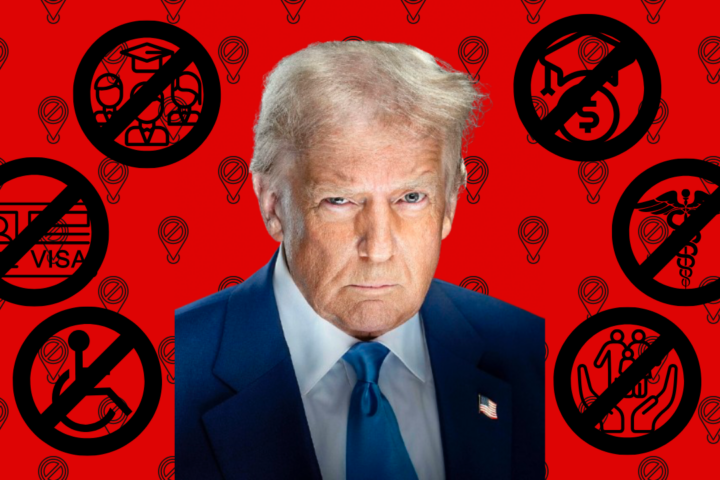
Graphic By Maya Uribe
The Trump administration’s relentless attacks on the federal government are not just political theater or a bid to shrink bureaucracy: they are a direct assault on people with disabilities, the poor, students and those living on the fringes of society, including rural communities. By dismantling social safety nets, undermining public services and prioritizing corporate interests over human needs, the administration is exacerbating inequality and deepening the suffering of those already marginalized.
At its core, this is not merely a conservative agenda to reduce government spending. It is a calculated move to redistribute power and resources upward, benefiting the wealthy and powerful at the expense of the working class and the most vulnerable. The administration’s policies are a stark reminder that the state, under capitalism, often serves as a tool for maintaining the status quo of exploitation and oppression.
The Assault on Students: How Policies Target the Poor, Immigrants and People With Disabilities
The Trump administration’s policies are expected to have a significant impact on low-income and disabled college students, many of whom rely on federal aid to pursue higher education. Programs like Pell Grants, which offer essential financial support to students from disadvantaged backgrounds, may face repeated cuts and a freeze on funds. If these reductions and freezes occur, many students could struggle to cover tuition, books and housing costs. The administration has targeted what it calls “woke ideology” (referring to awareness of social issues like racism and inequality, with some supporting it and others believing it goes too far) and Diversity, Equity, Inclusion and Access (DEIA) initiatives, raising concerns about whether these funds will remain accessible in the future.
With talk of slashing the federal budget for the Department of Education, with some openly discussing getting rid of the whole department, disabled students will see services that allow them to participate meaningfully in schools be cut from schools budgets. Trump’s Department of Education Secretary, Linda McMahon, had this to say during her confirmation hearing when asked about the Trump administration’s plans to abolish the Department of Education: “President Trump believes that the bureaucracy in Washington should be abolished so that we can return education to the states, where it belongs,” McMahon wrote, according to her testimony shared with HuffPost. “I wholeheartedly support and agree with this mission.”
They rationalize their cuts and rollbacks as getting rid of “woke ideology” and a return of education to the states that ultimately makes it harder for students to access accommodations and support services on campus, such as extended test times, accessible housing and assistive technologies. For many, the accommodations funded by the federal government are not luxuries, they are necessities that make higher education possible. When citing DEI, without the A, as to what they are against, they leave out access because they know denying disabled people the help they need is extremely unpopular. By weakening these protections, the administration is sending a clear message: disabled students are not only not a priority but also not worth investing in or respecting as individuals that are of value to society.
In 2025, the Trump administration has escalated its attacks on immigrant and undocumented students, making higher education increasingly out of reach. With renewed efforts to dismantle Deferred Action for Childhood Arrivals (DACA), thousands of students face the threat of losing their legal protections, forcing them to navigate school under the constant fear of deportation. Undocumented students were already barred from receiving federal financial aid, but the administration has gone further by pressuring states to eliminate in-state tuition benefits and restricting access to institutional scholarships. By systematically cutting off pathways to education, the administration is not just targeting immigrants—it is ensuring that working-class and marginalized communities remain trapped in cycles of poverty. The message is clear: education under capitalism is not a right, but a privilege reserved for those the system deems worthy.
Immigrant rights organizations have been vocal in their opposition. Maria Praeli, a DACA recipient and government relations manager at FWD.us, an immigration advocacy group, shared her perspective: “Undocumented students are already fighting an uphill battle to access education. Policies that cut financial aid and threaten deportation do not just hurt us, they hurt the communities we are part of and the country we want to contribute to.”
These policies are not accidental; they are part of a broader system that reinforces inequality. Higher education, under this administration, remains a privilege reserved for the wealthy, while poor and disabled students are left to navigate a labyrinth of debt, discrimination and bureaucratic hurdles. The consequences are far-reaching: students who manage to graduate often do so with crippling debt, while others are forced to drop out altogether, trapped in cycles of poverty and exclusion.
Terry Hartle, Senior Vice President of the American Council on Education (ACE), a prominent higher education advocacy organization, had this to say about this policy, “Pell Grants are the cornerstone of federal student aid, and any cuts to the program would disproportionately harm low-income students.” And later clarifying, “When you cut Pell Grants, you’re not just cutting aid for students—you’re cutting opportunities for millions of Americans to improve their lives and contribute to the economy.”
Senator Lamar Alexander, Republican from Tennessee who served as the Chairman of the Senate Committee on Health, Education, Labor and Pensions (HELP), argued, “We need to simplify the federal student aid system so that more students can take advantage of it. A simpler system will help students make better decisions about how to pay for college.”
By undermining access to education, the Trump administration is not just limiting individual opportunities—it is perpetuating a system that benefits the capitalist elite at the expense of the most vulnerable. Education should be a right, not a commodity, but these policies ensure that it remains out of reach for those who need it most.
Gutting Social Programs
The Trump administration is moving forward with sweeping cuts to social welfare programs, jeopardizing access to healthcare and food assistance for millions of Americans. A recently proposed budget plan includes nearly $880 billion in Medicaid reductions over the next decade, a move that would disproportionately impact low-income families, disabled individuals and the elderly. Despite previous assurances that the program would remain intact, President Trump endorsed the cuts, signaling a shift that could leave some of the country’s most vulnerable without life-saving medical care.
In addition to healthcare, the administration is targeting the Supplemental Nutrition Assistance Program (SNAP) with stricter eligibility requirements and limitations on what recipients can purchase. Under a new proposal, SNAP users would be restricted from buying sugary drinks and processed foods, a measure that critics argue does little to address the root causes of food insecurity. Rural communities, where grocery options are already limited, stand to be among the hardest hit.
Beyond direct cuts to healthcare and food assistance, the administration briefly attempted to freeze federal financial aid, disrupting critical funding for social programs. Although the directive was later withdrawn, it created uncertainty for those who depend on government assistance. Critics say these efforts reflect a broader pattern of reducing public support systems while prioritizing tax cuts and deregulation benefiting the wealthy.
The administration maintains that these policies promote financial responsibility and self-sufficiency, but opponents argue that they disproportionately burden the working class while benefiting corporations and high-income earners. As these proposals advance, millions of Americans face the possibility of losing essential support, deepening economic inequality and reinforcing structural barriers to upward mobility.
Supporters of these cuts include House Committee on Agriculture Chairman Glenn ‘GT’ Thompson who had this to say about the previous president’s administration and the USDA, “(the) USDA’s reckless accounting gimmicks under Secretary Vilsack were not just bad bookkeeping, they were an abuse of taxpayer resources and a violation of law. Ignoring their own financial experts,” Thompson says. “Biden’s USDA chose political convenience over program integrity and the financial standing of the department, a clear pattern of operation for the prior administration.”
However, critics argue that these policies are not about empowerment but about punishing the poor and marginalized. Angie Craig, (D) the Congresswoman from Minnesota that sits on the House Committee on Agriculture as a ranking member, had this to say about proposed cuts to SNAP and other food care programs, “Cutting farm bill nutrition programs does not make life affordable for everyday people.” Craig further added, “Instead of cutting SNAP to pay for handouts to wealthy donors, Republicans should prioritize helping working people and rural economies. Farmers and families are tightening their belts to make ends meet and cutting critical aid to our neighbors during a time of increased prices is not the answer.”
Eroding Public Services
The administration’s disdain for the federal government extends to public services that millions rely on. From underfunding public housing to rolling back environmental regulations, these actions disproportionately harm those with the least power to fight back. In rural areas, where infrastructure is already crumbling, cuts to federal funding for roads, schools and broadband internet further isolate communities and limit opportunities for economic mobility.
For people with disabilities, the erosion of public services is particularly cruel. The administration’s rollback of the Affordable Care Act (ACA) and its attacks on the Americans with Disabilities Act (ADA) have made it harder for disabled individuals to access health care, employment and accommodations. These policies send a clear message: if you are not profitable under capitalism, you are disposable.
For disabled advocates, the rollback of protections is particularly alarming. California Senators Alex Padilla (D), Adam Shiff (D)and 28 other Democrat Senators wrote a letter to President Trump and Elon Musk’s Department of Government Efficiency (DOGE) agency on the proposed Medicare cuts on the budget proposal Republicans are proposing in the House and Senate. This is what they had to say: “We write to say no to Elon Musk and DOGE, and demand hands off Medicare or Medicaid. We strongly oppose any efforts by Musk (or anyone else in your administration) cutting or damaging these vital programs. Medicare and Medicaid must not be raided to pay for tax cuts for billionaires,” wrote the Senators. “Every cut risks Americans paying more, waiting longer and wading through more insurance red tape for care. Every cut risks hospitals and community health centers struggling harder to keep their doors open and forcing health providers and workers out of their jobs.”
A System Designed to Fail the Vulnerable
The Trump administration’s assault on social programs is not just reckless policy, it is a deliberate strategy to reinforce the power of the wealthy while keeping the working class and poor in a state of desperation. Capitalism thrives on inequality, and these cuts to healthcare, housing and food assistance aren’t flaws in the system; they are its intended function. The federal government, when properly resourced, can reduce some of this inequality. But by gutting these safety nets, the administration is ensuring that the most vulnerable are left to struggle while the elite continue to hoard wealth.
This is not just about slashing budgets, it is about rejecting the idea that people deserve basic dignity. Healthcare, housing and food should be human rights, but under capitalism, they are privileges reserved for those who can afford them. The government is not failing; it is doing exactly what it was built to do—serve the ruling class while leaving everyone else to fight for survival.
Despite the administration’s claims of economic success, the reality for most working-class Americans tells a different story. The so-called “booming economy” (meaning a period of strong growth, with high production, low unemployment, and rising incomes) is nothing more than a facade propped up by stock market gains and corporate tax cuts that benefit the ultra-rich. Meanwhile, Trump’s promise to lower grocery and gas prices has proven to be yet another empty talking point. Egg prices continue to rise (Up 11% over the past month), gas costs still eat further and further into paychecks (Up 40 cents over the past month) and the overall cost of living, all while corporations post record profits. Instead of reining in corporate greed, the administration has doubled down on tax cuts for the wealthy and deregulation that lets big businesses keep squeezing consumers.
Wages remain stagnant, the cost of living continues to soar, and job security is increasingly rare. The administration touts low unemployment rates, but many of those jobs are low-wage, unstable and devoid of benefits by forcing workers into cycles of debt and precarity.
By dismantling social services while championing corporate greed, the administration is ensuring that wealth remains concentrated at the top. The working class is not failing under capitalism; capitalism is failing the working class. And as long as policies continue to prioritize profit over people, the cycle of exploitation will persist.
A Call to Action
The Trump administration’s assault on the federal government is a wake-up call. It exposes the fragility of the systems that millions rely on and the urgent need for collective action. For people with disabilities, the poor and those in rural areas, the stakes could not be higher.
To fight back, we must recognize that these attacks are not isolated incidents but part of a broader system of exploitation. We must demand a government that serves the people, not profits. And we must build solidarity across lines of difference, uniting the working class, people with disabilities, the poor and rural communities in a shared struggle for justice.
The time for passive acceptance is over. The time for resistance is now.
“The revolution is not an apple that falls when ripe. You have to make it fall.” ― Che Guevara, Revolutionary and former Minister of Industries of Cuba.
