
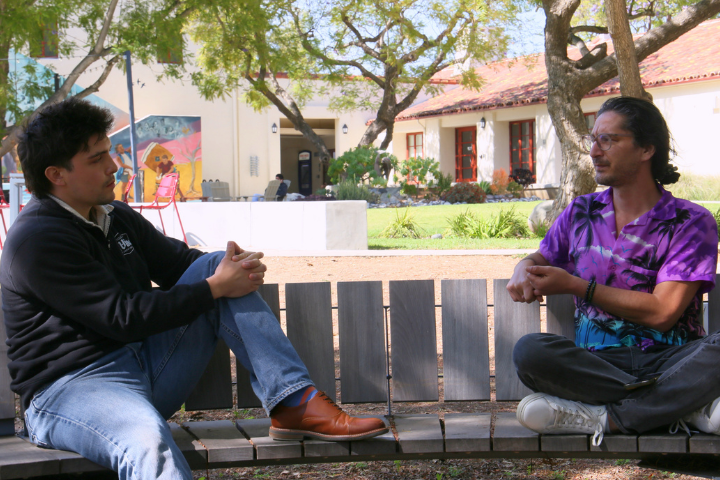
Photo by Madelaine Brown
By Timothy Walker
Timothy Walker:
My name is Tim Walker, and today I am with Jonathan Caravello, a CSUCI philosophy professor.
Throughout everything, how has your role as a professor been impacted, and how have students interacted with you throughout that process? Can you point to some of those moments?
Jonathan Caravello:
Yeah, sure. So, I was arrested back in July 2025, and we weren’t in session at the time. I wasn’t teaching. Fortunately, I had a month or two to adjust to the terrible bail conditions I was under because of the charges I was facing before I had to go back to work.
I was teaching a full load last semester. When we finally did start school in August or early September, those first days back did feel good, because I could escape into something I was so used to, something I had really poured myself into for so long.
But I also knew that I would need to talk to my students about the elephant in the room. So, during those first couple of days back, when I had my first session for each class, I had long conversations with them about what I was going through and how that might affect everything.
For the most part, in those early classes, I think about half of them already knew about it and half didn’t, which wasn’t so surprising, given the community here in the county. A lot of it, honestly, felt like business as usual, which was a weird feeling given what I was actually facing. I also had to take certain days off to go to court for my arraignments.
I had to obviously adjust how I talked to my students with respect to immigration-related topics. I didn’t really dull it down that much, but clearly, once students got used to me, some started asking whether they could see the video, asking what was going through my head, and asking me specific facts about the case. Legally speaking, it was not in my best interest to talk about those things as much as I wanted to.
That said, I eventually warmed up and felt like the class was, in some ways, a safe space for me. I never expected any of my students would go to the prosecution or the United States government and tell them I was talking crap about the feds or something like that.
The support I got from students, both from students I already knew and from students who were new to me, was incredible. Every single person I encountered was nothing less than very supportive of me.
Some moments I remember specifically are students coming up to me and saying they were with me, that their families were with me, that their abuelas were praying for me.
In one of my classes, two students came in after the first day of class and walked with me. One student, Esmeralda, gave me a little stone or ceramic ladybug and said she held it with her when she was having a tough time and wanted me to have it. That was very meaningful to me. I actually brought it with me to the trial a few weeks ago.
Another story: I bumped into a student I had about a year ago in a logic class. In true logic fashion, he was analyzing the situation very rigorously. He said to me, and this was the only person who said anything like this, “John, you did the moral thing, even if it wasn’t the right thing.”
And I knew exactly what he meant, practically speaking. I felt the consequences of this action, even if it was a morally responsible thing to do. I was the one who felt the brunt of the effects of it.
Otherwise, I’m close with a lot of students who have been my interns or worked as student organizers, with me as adviser for their organizations. A handful of those students were actually integral to the support team that was created to support me throughout the nine months before trial.
Timothy Walker:
That’s great. I mean, to have that almost rapport coming back. People knew about your experience and shared that with you, while still being able to work with you as is.
Leading off from that, how has your role as a professor shaped your approach toward the case? Maybe how you made decisions or communicated throughout the process, including with students. How did being a professor impact your ability to maneuver the endeavor as a whole?
Jonathan Caravello:
Yeah. On the one hand, obviously it was good to have work that I love to do as an escape from having to think about something so heavy all the time. But of course, I still had to uphold my teaching duties as I normally would.
The more menial stuff was actually easier than I expected. I had no trouble keeping up with grading and doing all of that. But I did feel a bit detached from my typical teaching style.
Often, I’d bring in very topical issues, and I still did that after I got back. But my mind was so consumed with the trial and everything going on with it. I wasn’t talking about it in detail. I wasn’t talking about the charge in detail. I would give some details to my students, but I didn’t go too far into teaching about it.
So, to be quite honest, I felt a bit lost in that sense. You’ve taken one of my classes. I don’t hold back. I’ll say what I believe about things, and I’ll be passionate about it. I found myself doing that less.
Perhaps that was a consequence, a chilling consequence, of being arrested and put through this stress and trauma. Other parts of it were simply that I was highly stressed from the whole situation. I was dealing with PTSD for the first time. Traumas I had never really experienced before were affecting both my body and mind. That’s been consuming me a little bit.
I still completed what I needed to complete, but maybe I didn’t go above and beyond in the way I normally would. One thing I definitely notice in retrospect is that I spent less time doing what I love most with respect to teaching, which is talking to students one-on-one or in small groups after class or before class, where we just walk and talk about philosophy, life, or current events. That’s something I would usually spend a lot of time doing.
I didn’t feel like I had the capacity to do that. The capacity I would normally use for that was thrown into preparing for the inevitable trial and each of the steps along the way.
And because I didn’t want to simply put my head down and only prepare for the inevitable trial so I could beat the charges, even though, of course, I did want to beat the charges, I also wanted to keep my head up and continue organizing within my union. So I was very involved in immigration-related union efforts throughout the last nine months.
Timothy Walker:
That’s great. Considering burnout is as common as it is, and everything you experienced, thank you for sharing that.
That also leads us perfectly into your experience with administration and faculty on campus, specifically CSUCI. Where did they stand within the process? Where did you feel supported? Where were things complicated? Where were the in-betweens?
Jonathan Caravello:
Yeah, sure. As I said, the students were amazing. They were with me.
Faculty, I would say, were exactly the same. I had a lot of faculty who I hadn’t been close to before reach out to me, along with the people I expected to reach out: my labor friends, my comrades, the coworkers who are heavily involved in the union work I am involved in. They were all right there every step of the way.
There were a few faculty, in particular, who stepped up into leadership positions to help organize the support team that met with me every single week. Last semester, I believe we met on Mondays, and then we shifted it to Fridays this semester. But we met every single week, giving updates, talking about what my needs were in those moments, and making sure we were continuing to build power as we readied ourselves for the inevitable trial.
I’ll shout them out: Kendall McClellan and Georgina Guzman, both in English, were two of my closest confidants during this whole process. Kendall, in particular, stepped into the lead faculty organizer role for my support team, which was bolstered by CFA, the California Faculty Association. Union members from various CSU campuses around the state, along with union staff and leadership, so graciously devoted themselves to this fight for me, to get me free.
So the faculty were amazing. I also can’t not mention many of the other employees on campus, including staff, Teamsters, maintenance workers, and skilled trade laborers. They were all very supportive as well.
I even remember some custodial staff seeing me one day and thanking me for what I had done.
We had a faculty- and student-led rally for me in March leading up to the trial, and employees from all different sectors of the workforce here on campus came out to support me. It was so powerful for me to see that.
As for admin, I’ll be straight up: I never once heard directly from any administrator here on campus.
I was, of course, aware of the message they released while I was in prison, stating that I should be released and that they would be getting my classes covered unless or until, as I read it, I was convicted. I never expected much from university management or the CSU at large to really do anything in support of me.
That said, I never got a hard time from them. I wasn’t put under heavy surveillance or anything. I was already dealing with surveillance from the state, with an ankle monitor tracking me everywhere, but I never had any problems with administration through this process.
I’m also aware that they released a statement after I was acquitted, which I didn’t read in full, but my coworkers assured me was a little bit weak. And that’s okay. Again, I didn’t really expect much from them.
There was an interesting situation earlier in 2025. I was given a letter of reprimand for my role in an anti-layoff action. Essentially, I was disciplined for violating the time, place, and manner policy, which is a repressive policy meant to restrict the time, place, and manner in which we protest on campus.
I yelled through a bullhorn without permission, and they gave me a letter of reprimand. It was placed in my file. I fought it throughout that spring with my union. We filed what’s called a grievance. It dragged out over the summer and was still hanging over me in the fall.
Eventually, it got wiped. Administration agreed to the terms of our request, which was to remove it from my file. Everything is fine with that now.
But interestingly, federal agents had taken my phone when I was arrested back in July. Eventually, they got into it, and they took just a couple of things from it. I knew there was nothing on there that was relevant or that would get me in trouble, so I wasn’t worried.
What they pulled out were two things: a list of Venmo transactions, which ultimately was irrelevant, and a downloaded version of my letter of reprimand.
They were actually trying to bring this in as evidence at trial.
I’m bringing this up specifically because I think it’s really important to realize that even violations in the workplace, violations of something like a time, place, and manner policy, are ways of criminalizing people. Even if you don’t catch a criminal charge because of it, although you can under the new time, place, and manner policy that was passed across the CSU this past year, it can very well come with certain misdemeanor criminal charges.
But even without that, it sets you up in such a way that it becomes part of your personnel record at your workplace that you are “disruptive.” And this can be rhetorically used against you in court.
That was what the prosecution was trying to do. They were trying to bring that in so they could paint me as some sort of violent agitator, saying, “He doesn’t just do this in the streets. He does this at the workplace, too.”
And the thought that something so ridiculous, me yelling through a bullhorn in a Grim Reaper outfit, no less, could be brought against me by the U.S. government in court, just made me think even more that these repressive policies have to go.
So, yeah, that was my general relationship to administration and other employees here on campus.
Timothy Walker:
Thanks for that. Go ahead and take a sip if you need anything after that.
Going a little further into what this all means: in recent interviews, you’ve talked about showing power without violence and about an obligation to act. What does that look like in practice for you? And where do you draw the line between and escalation?
Jonathan Caravello:
I mean, that’s a deep question, Tim.
You don’t have to draw the line between resistance and escalation. I think resistance can be escalatory sometimes, whatever you can do.
Timothy Walker:
Yeah. In recent interviews, you’ve talked about showing power without violence and about an obligation to act. You can focus on those two, and we can work from there.
Jonathan Caravello:
I’m an educator. I’m an education worker. So first, I’m a person, right? Then I’m a worker. And what kind of worker am I? I’m an education worker. Of course, I also think of myself as an educator.
It’s important to realize that, of course, in the worker sense, we’ve talked about the union stuff a little bit already. So I’ll talk about the education part.
What does it mean for me to be an educator when we’re sitting here in the belly of the beast, the most powerful country ever, but also the bloodiest country of all time, that continues to bomb countries around the world indiscriminately? What does it mean to actually be an educator within institutions that themselves are serving the interests of the U.S. empire?
How can I work within that system, in my workplace, to push back against those things, dismantle them from the inside, or maybe build other important, liberation-centered systems?
I think as educators, we have an ultimate obligation to work towards liberation.
The idea of liberation education goes against the typical view of what education is seen as in the United States. What it is often seen as is students who basically know nothing coming into your classrooms as empty receptacles to be filled. You fill them with your knowledge as the expert. That’s the competent one.
Timothy Walker:
The Banking Model.
John Caravello:
Yes the Banking Model.They go from incompetent to competent by filling themselves with the knowledge you’re there to provide. It’s transactional, which fits very nicely into a capitalist worldview.
Of course, there are going to be aspects of teaching where it’s like, “You’ve just got to know this. Listen, trust me, I know this stuff. I’m going to teach it to you.” Of course, there will be aspects like that.
But education in general should be geared toward helping a person, a young person or any person, transform, and, in my eyes, work towards liberating all people.
As someone who teaches philosophy, I have different ways of doing that, and often it deeply aligns with the content I’m teaching anyway, so it’s kind of easy. It may be difficult for a math professor, a physics professor, a chemistry professor, or a psychology professor to think of themselves as helping liberate students and helping students liberate other people.
But I had a really interesting conversation in my last class, or my last couple of classes, before my trial. I decided to shift away from what I would normally do in the class. We read some stuff from Pedagogy of the Oppressed by Paulo Freire, and we really talked about what education has been like for students as they come up through kindergarten all the way to college, and what it would look like if it were radically different.
I remember asking my students: imagine what it would be like if every time you walked into any class, the skills you were learning in that class, the content you were being taught, was all geared towards you liberating the world, liberating the land, liberating the people. Everything. Every single thing. Not toward getting you a job, not toward bettering the economy, not toward simply gaining skills, but everything geared toward liberation.
How quickly could we actually create the systems we need to replace the bloody ones that currently exist?
We had really, really good discussions about this. I wish I could teach about stuff like that every single day. I wish that was all I could talk about. And I wish I could give everyone A’s, because that’s the point anyway, right? Unfortunately, it’s also a job, and I have to keep it, so I have to follow some structures from my boss, of course.
To connect this to the action I got arrested for at Glass House Farms, only a couple miles away from Cal State Channel Islands: I had been by it many times. I knew where it was when I was informed that a raid, or a likely raid, was happening there.
So, of course, I went down there with a former student, actually. We had already been planning on patrolling that day in Camarillo anyway, so we just went straight down there late morning.
I didn’t think twice about it because, one, this is my community. Of course I’m going to defend my community members from being kidnapped by federal agents. That is what I view it as. It’s a kidnapping operation. It’s a kidnapping operation to collect people, put them in detention centers so those detention centers can profit off of them and, essentially, exploit their labor for free.
That’s what this is. It’s a way to mass incarcerate people. It’s a way to chill people. It’s a way to dehumanize them and further the goals of the empire. So, of course, I’m going to step up against that. I would do it anywhere, even if it weren’t close to my workplace or close to the school. I would still do it.
But the other thing is: how am I going to stand in my classrooms and talk about things like dissent, coercion, manipulation, violence even? How am I going to talk about those conceptually and philosophically, and then when the time comes to actually practice the principles and values that I discuss with my students, how could I not go out there and practice them? I have to.
And I want to be crystal clear: I did not go out there planning on throwing a tear gas canister or anything like that. I was thinking, “Shit, I don’t want to be here. This is awful. This is the last place I want to be right now.” But of course, I had to be there. It was my duty to be there.
So, getting back to your question about resistance and escalation: where is the line between those two things? I think that is one of the main cruxes of the issue here.
How do we figure out ways of fighting back that aren’t going to completely decimate the movement, aren’t going to put people in danger, and, if at all possible, aren’t going to harm anyone? Because the point is not to harm.
I also want to be clear, though, that violence has been used throughout history in every single revolution, in every single instance of people rising up against their oppressors. That is true. Violence has been used.
I would be careful obviously, and am not going to sit here and advocate for violence. I’m not a huge fan of violence. I wish there weren’t any. But I understand its necessity throughout history.
That said, to advocate for it right now in the United States, during protests against ICE, for instance, makes no sense to me, because there is nothing that would be gained. Nothing would be accomplished from harming them. And to coordinate something that would actually make an impact would put protesters at risk of going away for decades. It’s just not worth it. Like, why? To hurt a couple of ICE agents? What are you going to get out of that?
That said, I’ve been to hundreds of protests, maybe verging on a thousand at this point in my life. There are many different tactics, and many different ideologies that underwrite those tactics. I have never been, and likely will never be, part of tactics that are geared toward violence.
But I do think we have to be creative and think of new ways of fighting back.
I’ve been saying that, on the one hand, the state views it like this: either you’re a violent agitator and you’re going to be violent, or you stand “peacefully” on the side of the road and express yourself, as if those are the only two options.
Of course, that’s a false dilemma. There are other things you can do. We’ve seen it throughout the history of defending our civil rights. During the Civil Rights Movement, there were many instances of direct action that were entirely nonviolent.
Sit-ins are nonviolent. Are they against the law? Yeah, a lot of times they are. Blocking cars is nonviolent. Is it against the law? Yeah, it is. Can it be dangerous? Yeah, it can be dangerous. Not just disruptive.
Throwing tear gas canisters, okay, that hasn’t been a tactic used throughout history, but I often think about this: I’ve seen tear gas deployed at protests in the past. I’ve never actually felt the effects of it. Usually, I’ve dipped before it got too wild. But often I think, there should be a way that we can legally defend ourselves from the use of weapons against us.
More than simply wearing protective gear. When it comes down to it, if someone throws a chemical weapon at me, you bet your ass I’m not going to simply let it suffocate me.
There are a few options there. I could run away, but there are people around. Why do I have to run away? I can pick it up and throw it away. I know I could do that just as easily as running away, and maybe it would even be safer. It probably would be safer, me running away in a cloud of smoke when a bunch of other people are also running.
That’s probably more dangerous than me just picking it up and chucking it. I knew I wasn’t trying to hit anybody. I wasn’t intending to.
So, yeah, what’s the line between resistance and escalation? During the trial, they tried to paint me as someone who was escalating things. Because, for instance, I was blaring a siren through a megaphone, they called that escalatory.
And they pointed out how calm and composed the agents were during this time. Of course, that contradicted the behavior we saw in their body-camera footage, where they were high-fiving, laughing, taking glee in using tear gas indiscriminately against protesters, and even saying things like, “Rather than cause a diversion, let’s just gas the shit out of them like we did last time.”
And I know that is their general demeanor. That is how they feel. The reason they’re able to be calm and composed when someone is blaring a siren at them is because they’re trained to be there and put up with all that. And of course I’m trying to annoy them. Is it annoying or bothering someone escalation? It is a little bit of course it is. I’m not doing it to provoke violence, I don’t want violence, they’d already committed violence against us, and this is pushing aside the fact they are ultimately protecting a kidnapping operation. That itself is violence, the worst kind of violence.
Timothy Walker:
That actually leads us to a final question. After everything that has happened, what do you hope people on campus will take away from this? And what do you think they will take away from it?
Jonathan Caravello:
That’s a tough one. What do you think people will take from it?
Timothy Walker:
No, you’re okay. I mean, through my own experience, I think a lot of people have questioned whether or not your actions were, like you were saying earlier, pragmatically worth it. Maybe they see it as the morally correct action, but not the proper institutional action or the proper realistic action.
And I think when people see stories like this, they may motivate some. But I also think others may look at this and grow even angrier because they’re seeing someone with a level of access and privilege get away with something that many others themselves have not been able to, because they didn’t have the same access or support along the way. So I think it’s a pretty mixed bag.
Jonathan Caravello:
One thing is, I always worried, after this happened, that people would think what I was doing was adventurist, like I was just doing it because I wanted catharsis, because I wanted to feel good at that moment. But that wasn’t the case at all. I was very clear-headed and clear-minded when I took that action.
The main reason I did it, and I’ll just be real with you, is that about half an hour before, there had been an encounter with agents at the intersection of Las Posas and Laguna Road. Several ICE vans were trying to leave, likely with detainees. There were people who may have gotten in the way to try to stop the kidnapping operation, nonviolently, linking arms and things like that.
The agents deployed tear gas, and I understood why they would use tear gas in an instance like that. I detest the use of chemical weapons. I detest the operation they were protecting and conducting. But tactically, I understood why they were using it.
I got hit with it a little bit. It was my first time ever experiencing tear gas. I was choking, almost throwing up, on the side of the road, washing my eyes out. Then I saw an agent run down the road, look at a group of individuals who were all standing there feeling the effects of tear gas after the vehicles had already passed. They weren’t in the way of anything. And he just fucking chucked another tear gas canister at them.
I was like, “What? Are you serious?”
That was when I started talking shit to some of the officers, because I realized what was going on.
So, when I later watched them clear the way for two vehicles to leave on the shoulder of the road, with nobody in the way, and I saw one of them go to grab a tear gas canister, the first thing I thought was, “This fucker is going to throw a tear gas canister at us for no reason again.”
And he did.
So I actually went to kick it first, to kick it out of the way, because I thought, “I’m not just going to let you throw it at us for no reason.” I missed the kick, so I picked it up and threw it.
As a white person, and as someone who is viewed as professional in certain ways, I know going into protest that, one, I’m not going to be targeted the way people of color will be targeted. And two, if I do end up being targeted, detained, arrested, or charged, I will have a much easier time with the consequences of that.
In fact, I think sometimes it is the duty of people who have that privilege to take that on.
So I try to view it holistically. Looking back, what was accomplished by this? Who was harmed?
I was. I was the one who was harmed the most by my action. The people I love were harmed a little bit too, but they were also empowered. They came together. They uplifted me. In the end, I feel much more powerful than I did before.
I’ll always have that trauma from it. I’ll always have memories of it. It will be a story I have to tell for the rest of my life. But it has lit a fire under me even more to recognize what my purpose really is.
Part of that purpose is helping build some kind of movement of support, perhaps modeled after what I just received, so that we can extend it to other individuals who are being repressed, brutalized, arrested, and incarcerated for similar actions, or, to be quite honest, often for much lesser actions.
They never touch a tear gas canister. They’re standing on the side of the road. They’re being told to back up. They don’t back up fast enough, and they get fucking knocked to the ground, brutally arrested, and thrown in prison for a few days. That’s awful.
And that happens often. A lot of people don’t realize it.
But me, as a white professional, I had the privilege, or the benefit, of getting a pro bono, really good legal team. I had the full support of my union, my coworkers, my friends, my family, and my community. There were also eyes on me. The story was covered all over the place.
Knowing that, knowing there is such a heavy emphasis on what may seem like spectacular stories in our media apparatus, I knew I had to take advantage of it. Or I should say, we had to take advantage of it.
I’ve continually told every single one of my supporters that whatever is going on here is not just about me. Yes, of course, I’m going through this right now, but this is something much bigger. They are clearly trying to chill us from doing this really important work.
And by “really important work,” I don’t mean going to a protest and maybe throwing a tear gas canister. I mean defending our immigrant neighbors. That was a one-off. Like I said, it was the last place I wanted to be.
Months prior, I had been patrolling streets. I had been doing ICE watch. I had been helping run Know Your Rights workshops. I had been doing that work for a really long time.
And that work never stops. The attack on our liberties, our civil liberties, is not going to stop either. So I think we have to continue not just coming together in unity, but building power in whatever ways we can.
Timothy Walker:
Thanks. I think that’s a good way to put it.
There was one thing we wanted to clarify for context. Last question. There was the moment with the tear gas canister, but there was also mention of another one that was lodged underneath the wheelchair. Were those two separate canisters? One was tied to the arrest?
Jonathan Caravello:
Okay. So, the incident for which I was arrested happened around 1 p.m. I think it was around 12:50 or something like that. Two federal vehicles were leaving on the shoulder of the road. There was one person who kind of stood close to them and got pushed out of the way as they were rolling out.
One of the CBP agents rolled a gas canister at us. I went to kick it, missed it, grabbed it, and threw it. He hit me. When I threw it, I hit the ground. I backed up a little. He didn’t try to arrest me once he swung at me, though.
It wasn’t until two hours later that I got arrested.
At that point, they had sent the National Guard out, and they were marching forward a little bit. I was up near the line because I saw someone I knew, a friend and former student, recording really close. I was like, “Yo, it’s not worth it. Go away. I’ll do it.”
So I was recording, and I was recording because there was a guy in a wheelchair right near the line. I thought, “If they arrest this guy, I have to get this on video.”
He was next to a truck that was in the road. It had supplies, masks, and water on it, and there were boxes on the ground. I was throwing some of the boxes onto the truck because the agents were yelling, “Move this fucking truck,” and I was also recording.
I was standing on the bed of the truck when I noticed there was a tear gas canister lodged underneath the wheelchair. I remember looking at the agent and saying, “Oh, shit. I know we’re fighting right now, but there’s a tear gas canister underneath the wheelchair. I’m going to get it.”
So I jumped off the truck, bent down, and picked it up. At that point, because I had thrown one two hours before, I was mindful. I was thinking, “Look, just put it to the side.” And that’s what I did.
I think I grabbed one more box, put it on the truck, rose to my feet, put my hands up, and started backing up. By then, they had already circled around me. They grabbed me. They didn’t announce themselves or anything like that. They grabbed me, took me down, and kind of piled on top of me.
So when the news first came out, it looked like I was arrested for moving the tear gas canister away from the wheelchair.
In fact, I didn’t know about the news at that point. I also didn’t know exactly what I was arrested for. They didn’t tell me I was arrested or explain why until probably three or four hours later.
They drove me through the protesters, off the premises, off the road, through a back way by the glasshouse. They sat me out there for a couple of hours with some other people who had been arrested. Then they drove us to the military base at Point Mugu, and they sat me out there for another couple of hours.
It was there that some Homeland Security investigators that told me, “Yes, you have been arrested. We don’t know for sure why, but it’s likely assault or impeding a federal officer. Probably impeding.”
So I assumed they were trying to say I didn’t move back fast enough or something like that, or maybe that I had dislodged materials. But I was thinking, “That’s not illegal. What are you doing?” I didn’t really think it would be assault.
Actually, I didn’t know until probably a couple of days later, while I was in prison, when I finally talked to my brother on the phone and a lawyer who had gotten involved. That was when I realized, “Oh no, it looks like it’s an assault charge.”
It’s weird because assault and impeding or obstruction are under the same statute, so they can kind of just throw that charge at you and then pick later which one they’re pursuing.
So that’s what happened there.
Honestly, it was one of the hardest things to deal with when I got out, because people kept saying things like,“You’re a saint.” “You saved that guy in the wheelchair. They threw you in prison for that.”
That’s not why, but when I had people telling me, “Don’t tell others any facts of the case. Just let them believe that,” I felt so vexed. I was like, “No. That’s not why I was arrested.” They just used that moment as an opportunity to get me, which is fucked up, obviously.
And I did do that. Although, weirdly, I didn’t remember I had did it until I got out and people mentioned it to me. I was like, “I didn’t do that.” And they were like, “It’s on video, John.” And I was like, “Oh, Okay.”
Then I looked back and thought, “Oh shit, I do remember.” It was just so close to the arrest, and the arrest was one of the more overwhelming aspects of the whole situation.
Timothy Walker:
Yeah. I think your response as an ethics professor is pretty on cue.
Jonathan Caravello:
Yeah. I told my therapist I need to tell people the truth and they said no I don’t but I do! But I do add that people are understandably pissed off on my behalf for seemingly seeing me get arrested for saving a guy in a wheelchair, because that is something I did. I also did something else too. The other thing didn’t harm anyone either, but, yeah, it’s been interesting.
Timothy Walker:
Yep, the details are always important. Well, thank you for sharing your time, Professor. We appreciate you coming here for The CI View.
Jonathan Caravello:
Yeah. Thank you

After Jonathan Caravello’s ankle monitor was removed, Dr. Kendall McClellan and Dr. Georgina Guzman took him to the beach. According to Guzman, Caravello had not been able to bathe or go into the water for nearly nine months. The image captures one of his first moments regaining that small piece of freedom after continuing to teach throughout the case.
Photo provided by Dr. Georgina Guzmán
