
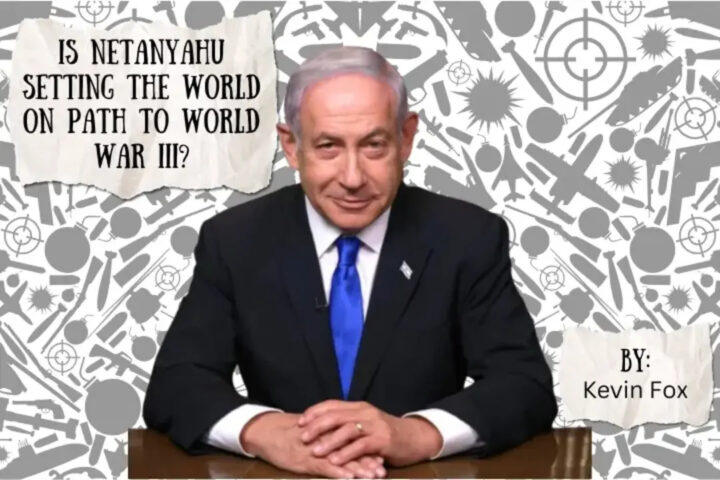
By Kevin Fox
Graphic by Maya Uribe
In recent months, Israeli Prime Minister Benjamin Netanyahu has faced growing criticism for his aggressive military actions and rhetoric, prompting many to ask: Is he deliberately pushing the world toward another global conflict?
Netanyahu, who has long maintained a hawkish stance on national security, has recently intensified airstrikes on Gaza, launched provocative operations in the West Bank, committed terrorism in Lebanon, assassinated the lead Hamas negotiator in Iran and leaked documents, showing his plans for a strike on Iran and exposed a desire for an escalation in conflict with Iran is in the works. The scope of these actions has raised alarm among international observers, some of whom argue that his policies are not just defensive but a calculated effort to escalate tensions throughout the region and perhaps the world.
Tensions between Israel and its neighbors have been high for decades, but Netanyahu’s latest maneuvers seem to be pushing boundaries even further. The bombardment of Gaza has left countless civilians dead, while his uncompromising stance on the Palestinian bombardment fuels ongoing protests around the world. 99 doctors from the west have maintained that they believe the death toll to have reached at least 118,000. Meanwhile, Israel’s recent terrorist attacks in Lebanon have reignited fears of open conflict with Iran.
Netanyahu has continually warned of Tehran’s nuclear ambitions, framing Israel’s survival as a battle against an existential threat. While Israel has legitimate security concerns from its neighbors and Arab majority nations due to Netanyahu’s irrational and aggressive actions, critics argue that Netanyahu is playing a dangerous game—one that could lead to a large-scale regional war, drawing in not just Middle Eastern nations but potentially the world’s superpowers.
Netanyahu’s government insists that their actions are necessary for the defense of the Israeli people. International experts believe that these moves are increasingly reckless and could ignite something far more dangerous, a conflict that has the chance to become the biggest conflict since World War II.
The International Criminal Court (ICC) has taken a historic step by issuing arrest warrants for Netanyahu and Israeli Defense Minister Yoav Gallant. The charges include alleged war crimes stemming from actions in Gaza and the West Bank, as well as violations of international law during Israel’s recent military operations in Lebanon.
“This is a moment of accountability for global leaders who act with impunity,” said Amal Al-Mazri, a human rights lawyer based in The Hague. “Netanyahu’s government has crossed numerous red lines, and the ICC’s warrants signify that the international community will not stand idly by while civilians suffer and laws are broken.”
The warrants have drawn mixed reactions. While many hail the ICC’s move as a step toward justice, others see it as a deeply polarizing action that could further inflame an already volatile situation. In response, Netanyahu dismissed the warrants as “political theater”, vowing that he would continue his policies unabated.
The unprecedented move by the ICC raises questions about its enforcement capabilities. With Israel not recognizing the court’s jurisdiction, it remains unclear whether these warrants will result in arrests or meaningful consequences.
Netanyahu’s rhetoric has also drawn widespread condemnation. In addition to his actions, he has made inflammatory comments that many critics describe as genocidal. In a 2019 statement, he reportedly referred to Palestinians as a “demographic threat,” a phrase human rights groups say dehumanizes an entire population and lays the groundwork for systemic oppression.
More recently, Netanyahu was quoted saying that Arabs in the region are “the enemy within” and that “we must crush them, not coexist with them.” These remarks have been seized upon by activists and international observers as evidence of an alarming mindset that prioritizes domination over diplomacy.
“Netanyahu’s comments are not just reckless—they are dangerous,” said Dr. Amal Al-Mazri, a human rights lawyer based in The Hague. “When a head of state uses language that dehumanizes entire populations, it emboldens violence and escalates tensions.”
Two days after the October 7 Hamas attack, Israeli Defense Minister Yoav Gallant referred to Palestinians in Gaza as “human animals,” justifying a complete siege of the territory. Deputy Knesset Speaker Nissim Vaturi, from Netanyahu’s Likud party, took to social media to declare that Israel’s common goal was “erasing the Gaza Strip from the face of the earth.” Meanwhile, Israeli Heritage Minister Amichay Eliyahu, from the far-right Jewish Power party, suggested that Israel should consider using a nuclear bomb on Gaza, stating that there were “no uninvolved civilians” in the territory.
The igniting conflict with Iran, for example, is not just a bilateral issue. The United States, a longtime ally of Israel, has pledged support in the event of a military confrontation. Meanwhile, Russia and China have signaled their willingness to back Iran. With these global powers involved, any military engagement between Israel and Iran could quickly spiral into a broader international conflict.
Russia’s Deputy Foreign Minister was quoted as saying this about the ongoing conflict with Iran, “We have repeatedly warned and continue to warn, to caution [Israel] against even hypothetically considering the possibility of a strike on [Iranian] nuclear facilities and nuclear infrastructure.”
The Chinese Ambassador to the UN, Fu Cong, said this at the UN Security Council, “At present, an all-out war is on the brink of breaking out,” he warned, adding that “At this critical juncture, any inflammatory statements and provocative actions are extremely dangerous. They could easily lead to miscalculations and chain reactions, escalate the situation, and even make it completely out of control.”
If Israel were to become embroiled in an all-out war with Iran, China, and Russia, the consequences would be nothing short of catastrophic. Israel’s geographic and military limitations would make it heavily reliant on its strongest ally, the United States. The U.S., bound by a long-standing commitment to Israel’s security, would face significant pressure to intervene. This could range from sending advanced military aid to deploying American troops in the region, risking a direct confrontation with other major powers.
The economic impact would ripple globally, likely resulting in rising oil prices, heightened cybersecurity threats and disruptions in international supply chains. Domestically, the U.S. could see political divisions deepen, as American leaders and citizens grapple with the risks of involvement in such a complex and multi-faceted conflict. The stakes for the global balance of power would escalate rapidly, placing intense pressure on diplomacy to avoid a war that could spiral into widespread, potentially nuclear, devastation.
Political science professor, Dr. Sheen Rajmaira, had this to say about the situation, “Netanyahu is expanding the scope and duration of this conflict to distract from his corruption trial which is set to begin in December. So far it appears the Jerusalem District Court is not willing to accept the PM’s argument that the country must not be distracted from its fight and should delay the trial.” Dr. Rajamaira added, “It is also clear that in an increasingly globalized world, the distinction between foreign and domestic policy is becoming quite blurred. This war is a good illustration of the intricacies of war in a time of globalization.”
Besieged by corruption charges and facing massive protests over judicial reforms, Netanyahu may be using military escalation to shore up nationalist support and distract from his political troubles at home.
Benny Gantz, former Israel War Cabinet member, was quoted saying back in April of this year, “We must agree on a date for elections in September, towards a year to the war if you will. Setting up a date for elections will allow us to continue the military effort while signaling to the citizens of Israel that we will soon renew their trust in us.”
As tensions continue to rise, the international community is left watching, waiting and hoping that Netanyahu’s brinksmanship does not trigger a catastrophic conflict. But as military operations intensify and threats mount, the question remains: Is Netanyahu trying to protect Israel, or is he on a path that could lead to World War III?
