
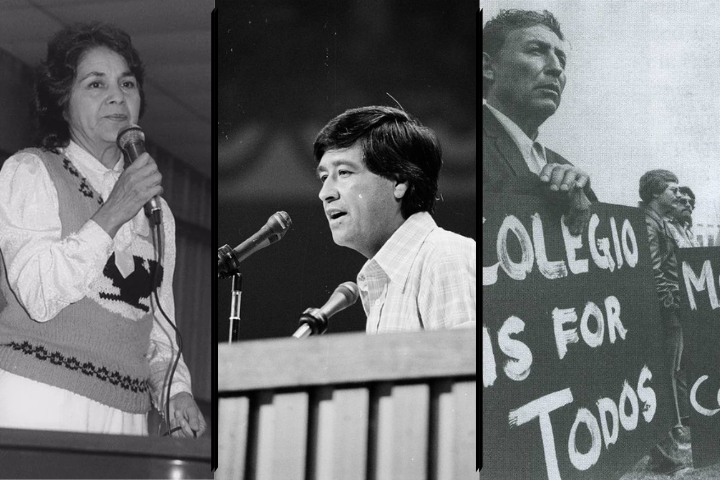
Copyright-free photos from left to right: Dolores Huerta, curtesy of Picryl; César Chávez, curtesy of LOC’s Public Domain Archive; and a farmworkers’ rights protestor, curtesy of Wikimedia Commons
Written by Timothy Walker
César Chávez, co-founder of the United Farm Workers, has been the subject of allegations raised in a March 2026 investigation by The New York Times, reporting that he sexually abused women and girls over a period of years.
One of the most significant accounts came from Dolores Huerta, his longtime collaborator. On March 18th through a statement on her Instagram account she stated that Chávez pressured her into sex on one occasion and sexually assaulted her on another during the 1960s. She said both encounters resulted in pregnancies, with family members raising the children and that she kept the paternity private for decades out of concern that revealing it would harm the farmworker movement she had spent her life building.
Silence here was not a single moment of inaction, but a condition sustained by overlapping personal, political and structural pressures.
In an interview with ABC News, Huerta spoke cautiously about the experience when asked directly if it was rape, stating, “One could, how shall I put it, you can name it what you name it. When you’re forced into a situation of unwanted sex, I think you can consider it rape.” Her phrasing reflects difficulty in directly labeling the experience, showing how language, memory and public responsibility can complicate how such events are described.
The investigation also included accounts from two women who allege Chávez began abusing them at approximately 12 and 13 years old, with claims describing grooming and continued abuse over time.
Taken together, these accounts indicate a pattern beyond isolated incidents, though the full extent remains under evaluation.
Despite these allegations, Chávez was publicly framed for decades as a moral leader within the movement. In a 2019 public statement, Huerta described confronting workplace sexual misconduct and portrayed Chávez as someone who would not tolerate such behavior. She recounted an incident in which a young Latina farmworker reported being denied pay unless she agreed to sexual demands from a board member. Huerta said Chávez removed the individual from a meeting and confronted him privately on a long walk, after which the man appeared chastised.
Some critics argue that the timing and framing of these allegations reflect political tensions, noting that Chávez held views on undocumented labor that differ from many contemporary progressive positions. In past remarks, Chávez attributed significant job loss among citizens to undocumented workers and used language that today is widely considered offensive, referring to them as “wetbacks.” These positions complicate his legacy and contribute to debates about how historical figures are interpreted through modern political lenses. However, claims that the allegations themselves are politically motivated remain speculative and are not supported by direct evidence.
This tension is better explained through overlapping personal, political and structural pressures within the movement. As a leader, Chávez maintained a highly centralized role within the UFW, controlling strategy, messaging, and internal operations. His leadership organized marginalized workers effectively but also concentrated authority and limited dissent. Workers and organizers often depended on the union for both representation and financial stability, reinforcing his influence.
That concentration of power made accountability difficult, especially when the movement’s success was tied to a single figure.
Within this environment, Huerta’s silence was not isolated. Alongside her political partnership with Chávez, she later formed a long-term relationship with his brother Richard Chávez and raised children within that extended family network. While this relationship began after the alleged incidents, it likely reinforced her continued silence. As her personal and family ties deepened, the consequences of speaking out expanded beyond the movement to include her own family and children.
The historical context adds another layer. In the 1960s and 1970s, reports of sexual abuse were often dismissed, especially when involving minors or marginalized communities. Victims faced stigma, disbelief, and retaliation, discouraging reporting. Within activist spaces, the pressure to protect collective goals further reduced the likelihood that such allegations would surface publicly.
At the same time, Chávez’s contributions to the labor movement were significant.
Through strikes and boycotts, he brought national attention to farmworker conditions and helped improve wages, working conditions and labor rights. His emphasis on nonviolent protest and grassroots organizing reshaped labor activism in the United States, contributing to his reputation as both a labor and civil rights leader.
Some critics urge caution in evaluating the allegations. Much of the evidence relies on retrospective testimony, and Chávez is no longer alive to respond. Others point to the decades-long gap between the incidents and their disclosure, arguing this complicates verification. These concerns highlight real challenges but do not fully account for the social, institutional and personal pressures that can delay disclosure, especially in environments shaped by power and loyalty.
Chávez’s legacy shows how movements can contradictingly produce social progress and human abuse, and how maintaining a movement’s strength can depend on what is left unsaid.

