
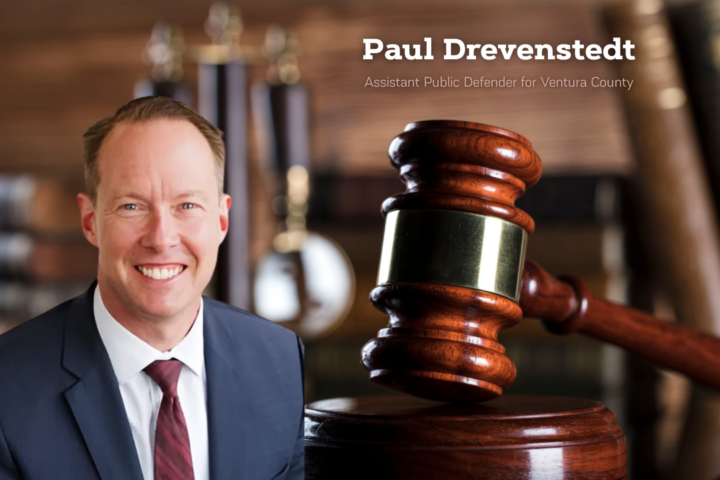
Graphic by Melisa Rodriguez
By Miggy Aguilar
Paul Drevenstedt, Assistant Public Defender for Ventura County, spoke to students at CI, offering a glimpse into the role of public defenders and the broader challenges within the American legal system.
Drevenstedt, who helps oversee an office of 65 attorneys and 70 support staff, explained that public defenders handle approximately 80 percent of criminal cases filed by the District Attorney’s Office. These cases range from misdemeanors such as DUIs and urban camping violations to serious felonies, including homicide and gang-related offenses. Beyond criminal defense, his office also manages mental health cases, juvenile representation and reentry programs for formerly incarcerated individuals.
One of the central themes of his discussion was the emotional and ethical weight of public defense work. He noted that while many assume the most difficult cases involve violent crimes, the greatest challenge is defending clients he knows to be innocent. The pressure, he explained, comes from knowing that a single mistake could mean wrongful incarceration for his client.
“The hardest cases are not necessarily the most serious ones,” Drevenstedt told students. “They’re the ones where you know your client is innocent, and if you fail, they lose their freedom.”
Drevenstedt also highlighted the interconnected nature of criminal defense and social services, explaining how public defenders collaborate with Ventura County Behavioral Health, probation agencies and local reentry programs to support clients beyond the courtroom. He specifically discussed mental health diversion laws, which allow individuals with qualifying diagnoses to receive treatment rather than face felony charges.
“The legal system is not just about punishment,” he said. “A big part of what we do is helping clients break the cycle of incarceration and reintegrate into society.”
Students also heard about the workload and career realities of public defense. Drevenstedt explained that felony attorneys often juggle more than 40 cases at a time, some of which take years to resolve. Despite the heavy caseload, he described public defense as an ideal career path for those interested in courtroom experience and criminal justice reform.
In response to a student question about burnout, he acknowledged that public defense can be emotionally taxing but clarified that job satisfaction comes from knowing the work makes a difference.
“I feel lucky that my job aligns with my values,” Drevenstedt said. “Not everyone gets to say that.”
For students at CI looking to pursue careers in public service and law, Drevenstedt’s work as a public defender serves as a shining example of how the American legal system can protect the human rights of defendants as well as provide them with pathways to rehabilitation and reintegration into society.
