
Graphic by Dani Ramirez
Written by Hunter Harding
The Oxnard brothers’ sugar beet industry, American Sugar Beet Company, first put Oxnard on the map as an agricultural city. However, the hands that labored for them and on the surrounding farms have historically received very little support and recognition. Today, many of those same workers face increased scrutiny under current immigration policies.
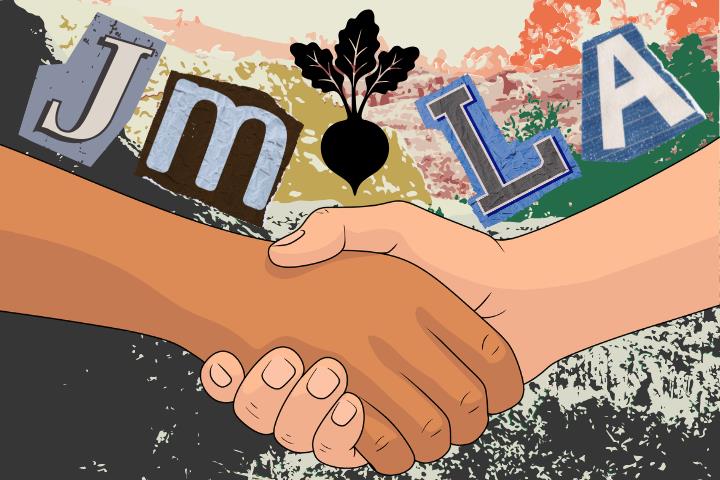
The Japanese Mexican Labor Alliance
According to the Central Coast Labor Council, the American Sugar Beet Company created the Western Agricultural Contracting Company in 1902 to contract out agricultural workers. When the Western Agricultural Contracting Company lowered wages in an effort to increase their profits and began pitting the Japanese and Mexican workers against one another, 500 Japanese, 200 Mexican, and some Chinese sugar beet workers went on strike for 48 days, beginning on Feb. 11, 1903. This organization of laborers launched the first multiethnic agricultural strike in California history.
After a monthlong standoff, five members were shot and one was killed on March 23, 1903 while attempting to hang a JMLA banner on a strikebreaker’s wagon. On March 30, 1903 the strike ended with the farm owners agreeing to contract directly with JMLA, leading to fairer conditions for their members. During the strike JMLA membership soared, the Central Coast Labor Council reported its members accounting for over 90% of the sugar beet farmworkers in Ventura County.
Despite this historic win, the JMLA took a blow that same year when they requested membership in the American Federation of Labor as the Sugar Beet and Farm Laborers’ Union of Oxnard. The American Federation of Labor declined the request, wanting only to accept Mexican members and exclude Japanese members. The JMLA refused to break solidarity within its alliance, leading to the slow disappearance of the JMLA and seemingly any hope for strong farmworkers’ unions in Ventura County. Approximately only 4.3% of California’s agricultural workers were represented by a union in 2022, according to UC Davis’ Rural Migration News.
CSUCI Student Speakers
In addition to other speakers, the event featured two CI students: Sergio Gonzalez and Alexander Fernandez. Both students were enrolled in ENGL 331, Narratives of the Working Class, during the 2025 Fall semester and reflected on their experiences in the course. ENGL 331 is a service-learning course partnered with the Central Coast Labor Council in which students compiled a zine for the JMLA Gathering. The course examines the lives of working people through literature spanning various industries and eras and asks students to respond to the material creatively.
Gonzalez said his experience growing up in Oxnard and working with students in local schools shaped his perspective in the course and his interest in amplifying working-class voices. “Working with kids in a low-income neighborhood,” Gonzalez stated, “it’s like, these are not only my parents and uncles, but these are their parents, their uncles. It’s just like a cycle, it’s not necessarily guilt, but a need.”
Gonzalez said that the class has demonstrated why the voices of the working class are so important. Taking ENGL 311 “revealed what the working class actually is, it’s a lot more people than you’d think, and how nuanced history is.” He argued, “A representative is not enough for representation; one single person cannot get the whole nuance.” Empowering the voices of the working class allows individuals to be heard and to represent themselves.
In an interview, Fernandez demonstrated why the history of the JMLA is important to be aware of in today’s climate. “What’s happening now that you see with ICE and what have you, you’re seeing Latinos in general being used as a scapegoat for a lot of things, being blamed for a lot of things.” He went on to illustrate the connections between the current targeting of Latinos and the Japanese internment during WWII. “That also led to just general antipathy against Asians of all stripes.” Americans are seeing that same ignorant racial profiling today, too: “A lot of people, even though they might be from Puerto Rico, they’re still being singled out by ICE even though they’re American citizens.” Regardless of citizenship status, people of color are being targeted by the recent immigration policies put in place, living under constant threat.
Fernandez said that citizens must be aware of the patterns from yesterday that spill into today and, most importantly, learn from them. “These kinds of things happened in the past and through organization, through stuff like labor organizing, unions, you see communities come together, for example, the JMLA.” The members of the JMLA crossed ethnic lines to fight unfair treatment by the farm-owner class, creating a network of support for one another.
Fernandez suggested that having strong farmworker unions and solidarity across the entire working class today would change how ICE conducts raids. “If you are being taken and detained, then by being a member of that union, you have people that are willing to look out for you.” Unions would provide protection, support, resources, and representation for agricultural workers being targeted by immigration policies. Fernandez also stressed the strength in solidarity amongst the global working class, which comprises the vast majority of the world’s population. “Because basically everyone is part of that group, it connects people; it doesn’t matter what ethnicity you are, if you are a worker, then it’s in your interest to band together with other people that are also part of the laboring class in order to negotiate and advocate for yourself and your community.”
Hands-on Zine Workshop
Kendall McClellan, a CI English professor who taught ENGL 331 last semester and serves on the JMLA event-planning committee, led a zine workshop in which attendees learned how to make zines with purpose.
First introduced to zines growing up during the grunge era in Portland, Oregon., McClellan was recently inspired again when introduced to Evan Chelsee, the co-founder of Biggest Little Zine Fair, through a writing group. “Zines provide people with a way to circumnavigate the requirements of establishment publishing,” McClellan states in an interview. “The whole ethic of zine, right, is that it’s a representation of really an individual, or group, or community group on their own terms, and that’s a very powerful thing to have access to politically as a form of expression if you’re somebody whose voice isn’t really raised or honored in the mainstream.” She goes on to say: “It puts the power in the hands of the maker.”
McClellan decided to teach a service-learning course with the assignment of a zine not only because of the power of zines, but also because of today’s compulsion toward digitalness. “In the face of AI and in the face of overwhelming sort of political forces right now, it felt really right to do a project that was personal for the student, that asked for creativity, and that was like a hands-on kind of experience.” The class-made zine project was a no-brainer.
“This event feels particularly important this year because of the treatment of farmworkers,” McClellan said about the JMLA gathering, “because of the threats that farmworkers are now living, the threat that they’re now living under with ICE, because of the attacks on, in particular Chicano citizens and non-citizens in our country, right, like the racial profiling, the raids in our own community at Glasshouse farms, right so it feels very, very important to honor agricultural laborers in our region, which this event will do, and to look to the past for lessons in solidarity.” The event not only taught about the past, but also about how we can utilize history today. “That’s really what this event is about, like yes it’s about commemorating the 1903 Sugar Beet Strike, but really it’s also about like what do we have to learn from this strike and why is a strike like this important to know about now, like how can it empower us, and encourage us, and sort of inspire us to create more networks of support for farmworkers.”
McClellan stressed the importance of young people in particular getting involved in their community during uncertain times. She urged for students to attend events like the JMLA gathering because “it’s a way of connecting to community resources, to learning about the role labor unions can play right now, it’s a show of support, right, for farmworkers and the farmworker community, but I think really it’s just like now is a time when we need community and we need to be connected to one another in a way that when something happens, we know that there is a sort of like a spider web of support.”
She goes on to say, “One of the things I hope is that young people right now are seeing what’s happening and that it is making them care more not less about being involved, and about having a voice, and about fighting to like protect democracy, and to protect the possibility of having a voice and all of this stuff is a like a way to do that, right like it’s very overwhelming when your thinking about it as like a vote for president, like that doesn’t feel meaningful, what feels really meaningful, I’ve found over time, is the little ways that you can get involved in your local community.” These little things may seem inconsequential, but when done by people across the nation, they create something truly powerful. Events like the JMLA gathering are ways for students and young adults to become more involved in their local community.
