
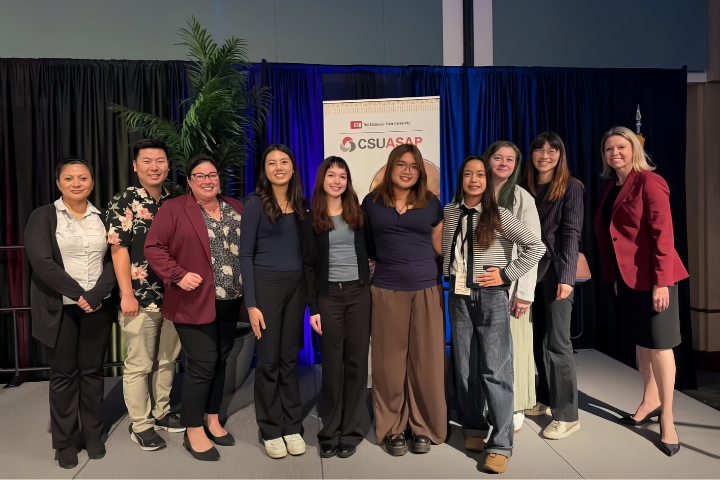
Left to right: Hannah Smit, Kevin Hayakawa, Michelle Hasendonckx, Minda Tran, Cristina Sutton, Hannah Binuluan, Priscilia Iglesia, Julia R. Heck, Nancy Chien, Interim President Dr. Susan Andrzejewski
Photo by Minda Tran
Written by Priscillia Iglesia
Kimchi is a dish made with careful precision and patience, with each ingredient being carefully prepared, salted and seasoned while being fermented over time. In previous generations, Kimchi was used as a custom to preserve vegetables through long, harsh winters, when food was scarce. In the middle generations, Kimchi-buchimgae, a crispy kimchi flour pancake filled with green onions, was used as an easy breakfast but filling meal. Generations now have modernized the kimchi game using various combinations such as Kimchi Cheesy Fries or Pasta.
It begins as a simple side dish, becomes a staple rich in tradition but shaped by different yet equally valuable processes. Cultural traditions continue to be deeply rooted in culture, yet consistently grow beyond the confines of limitation.
Through the California State University’s Asian American and Native Hawaiian/Pacific Islander conference, cultures have not only become a way to preserve tradition but a way for generations to break away from confinement. Because of this, the importance of being in an Asian American and Pacific Islander community contributes to creating a campus where individuals can be seen and heard. By facilitating events such as the CSU’s newly founded Asian Pacific Americans in Higher Education conference, students within the AAPI community are empowered to not only share tradition but also are given the opportunity to advocate against harsh generational norms.
While conferences such as the AANHPI highlight the strength of a collective voice and cultural celebration, they also illustrate the importance of exploring the lives of AAPI students on campus. Emphasizing the generational expectations and cultural norms within the AAPI community that have shaped their experiences.
Gaps that address and acknowledge these realities are required in order to foster support and connection among students.
Elizabeth Paguia, an on-campus resident and psychology sophomore, emphasized the importance of community engagement in fostering deeper understanding and connection within the AAPI community.
Being a part of the Filipino community, Paguia also mentioned the generational standards and pressure when faced with academic and student life on campus. “That’s kind of the Filipino way, is being academic, being on top, it’s always driving for perfection,” Paguia said.
Her reflection illustrates how students’ passions and experiences on campus are potentially influenced by cultural norms regarding achievement. Engagement with the community might be a priority when academic achievement is the primary sign of success. Events such as the AANHPI conference are crucial because they provide students with an opportunity to interact and think outside the box.
Through the AANHPI conference, representatives were not only able to break away from the pressures of academic life but also engage in meaningful conversations with other members of the AAPI community. Attendees were also able to network with individuals from other CSUs and community college campuses, fostering meaningful connections that form a strong foundation within the AAPI community.
Cristina Sutton, an AANHPI representative and psychology senior, highlighted the importance of representation and empowerment through conferences such as these.
“We have to network with each other, and see how CSU ASAP continuously provides through improving graduation rates and retention rates for AAPI students,” by Cristina Sutton, psychology senior and AANHPI representative.
Her remarks underscore that these gatherings strongly promote student achievement and go above cultural celebrations. Conferences like the AANHPI promote community support and long-term academic achievement for AAPI students through fostering collaboration.
The perspectives of two other AAPI student representatives who took part in AAHNPI further highlighted the importance of the conference.
Minda Tran, an AANHPI representative and liberal studies junior with a concentration in mathematics, reflects the event’s influence, demonstrating the way it benefited participants and raised awareness on the accomplishments of the AAPI community.
“Every single person I met shared the same goal of wanting to support our AAPI communities on our campuses,” Tran said. Her experience established a sense of community through interactions with individuals who matched her passion for helping transform everything around her, while establishing a space where members of the AAPI community can advocate for themselves.
Hannah Binulaan, another AANHPI representative and a health science senior, said, “We talked about what we’re doing on our campus for the AAPI population and talking to them about that really made me feel like what I was doing really made a difference.”
Her reflection demonstrated that not only did the conference acknowledge the dedication of college students, but it also recognized promoting the AAPI community and encouraged collaboration across campus. Through shared experiences, ideas and laughter, representatives were reminded that their shared goal contributes to a larger, collective movement.
Just as the use of Kimchi evolves across generations, rooted in tradition as well as transforming in different perspectives, the AAPI community on campus continues to evolve through individuals who advocate through representation, connection and change. Summits such as the CSU’s AANHPI provide students, faculty and staff the opportunity to celebrate cultural diversity, while also addressing the generational expectations as well as challenges many AAPI students face.
By bringing together individuals from diverse backgrounds, campuses are able to connect with each other on a deeper level. These gatherings help preserve cultural traditions while creating spaces where new ideas and connections can develop across generations. In the same way, fermentation strengthens over time; these gatherings continue to strengthen, creating friendship and shared understanding across generations.
