
Graphic by Dani Ramirez
Written by Priscilia Iglesia
All superheroes face a daunting battle: defeating a villain who terrorizes the city, rescuing citizens from a nearby fire or even helping an elderly lady retrieve her cat from a tree. Yet incoming students are fighting their own battles — equally significant ones. The villain? Social isolation and its destructive effects on mental health.
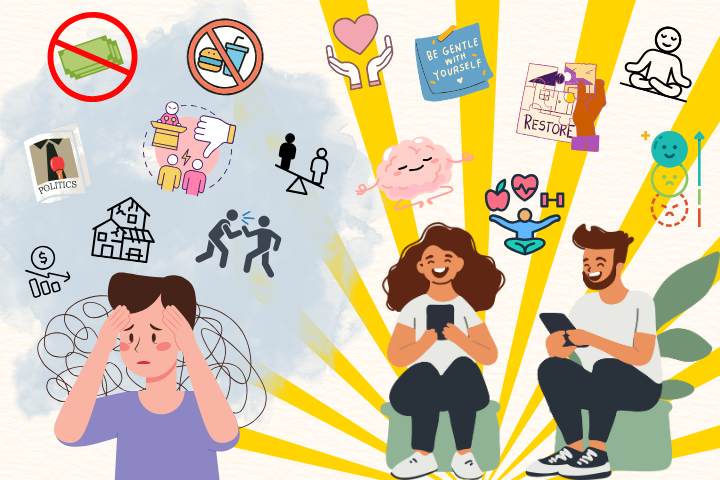
Social isolation has been a growing concern among college students, particularly in California. According to EdSource, at least 60% of college students said they experienced mental health struggles, which were linked to hostile politics, violence, wealth disparities and other unknown factors. In addition, there was a significant origin of stress found in college issues, which included social isolation, financial worries and a competitive culture.
Behind each statistic, students face a continuous battle against the main villain: social isolation, slowly waiting to strike in a moment of weakness. When a young hero’s work is done, who can they truly depend on when their weaknesses begin to break their armor? Prioritizing simple access to mental health resources is the key to combating the harmful effects of social isolation and protecting the emotional well-being of our heroes.
As these challenges continue to grow, a signal for a courageous response emerges. In this modern world of screens and technology, help can come in many forms — whether it is a superhero in spandex or a digital platform designed to help. And when it comes to mental health support, existing platforms developed by the state are stepping up to the challenge.
Developed under the CalHOPE umbrella and in partnership with Kooth Digital Health and the California Department of Health Care Services, Soluna is a free online platform battling against young adults’ everyday villains.
Free digital platforms and tools are addressing major holes in the mental health care system, empowering young adults to receive the assistance necessary with the support of public state funding. As current systems are overwhelmed, publicly supported systems that include Kooth and Soluna indicate that online mental health care platforms could be lightning fast, free of stigma and uniquely tailored to satisfy the needs of young adults’ mental health.
Soluna offers no-cost, confidential mental health services with no insurance, referrals or long waitlist; eliminating the downsides of regular mental health care. In addition, Soluna offers a variety of tools, including one-on-one coaching with professional mental health coaches, guided breathwork, journal prompts, a noise cleanse and a supportive community forum. Not only is coaching free and available, but it is also available in English, Spanish and 17 additional languages through telecoaching. This feature makes the service available to California’s diverse communities.
“I finally feel like I am able to talk with someone, and it takes a huge weight off my shoulders. Being able to talk to someone trained to help me for no charge is wonderful, and I am happy to be able to use the app and talk to people about my problems when I need to,” a Soluna user testified.
The pandemic has added another layer to this ongoing struggle. The “kryptonite” effects of COVID-19 left many students feeling socially stuck. Throughout the battle against COVID-19, students have felt weakness through the negative mental health impacts of social media and social isolation. The isolation and uncertainty caused by the pandemic amplified existing mental health challenges, making the need for support even more urgent.
Olyani, a junior at King/Drew Medical Magnet High School in Los Angeles, said it “Probably made us more aware of mental health struggles that previous generations would not have been exposed to.”
In a heroic response, California invested $4 billion in mental health, creating a stronger “shield” for crucial mental health resources, including therapy, counselors, and crisis teams. Behind every hero is a strong team, and so California collaborated to create an Avengers-level team, becoming part of a victorious mission. The Soluna app, being a part of this initiative, acts as a sidekick, helping our heroes become the best version of themselves.
When our heroes face the battle against social isolation, their mental wellness can suffer. Numerous individuals face challenges every day, but with the right tools, community support and cost-free support systems in place; they can become relentless forces of resilience and change. Now is the moment we need to unmask the disguised struggle and support our heroes by lending the helping hand they need.
It is essential to recognize that no one is invisible; even the most resilient heroes need a team they can rely on. True power has become far greater than resilience, but additionally requires growth, self-awareness and the courage to seek aid. The journey to becoming a hero involves making every effort for self-improvement, day by day, with the help of individuals who support their heroic endeavors. In the words of Iron Man in Avenger’s Endgame, “Sometimes you can not do it alone.” The good news is, no one has to.
Soluna is not a crisis support. If you need urgent support, call the crisis lifeline on 988. If you or someone you know is struggling, there are resources, support, and people who care. Visit cybhi.chhs.ca.gov to learn more about services available and discover ways to be part of the solution.
Priscilia Iglesia is a senior student studying psychology. She serves as a Soluna ambassador under the DCHS.
