
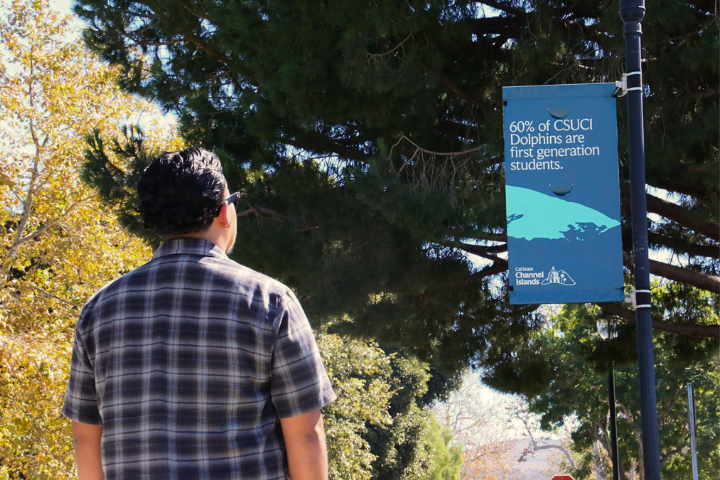
Sergio Gonzalez, a first-generation student, in front of a banner on CI’s campus
Photo by Dani Ramirez
By Esmeralda Meckler
Para leer el articulo en Español, presiona aquí: https://civiewnews.com/features/estamos-descubriendo-la-experiencia-de-estudiantes-de-primera-generacion-parte-3/
For the final part of our series, “‘We’re figuring it out’: The first-generation experience,” we’re hearing from Sergio Gonzalez, a senior English major and Estephania Mendoza, a junior transfer student majoring in early childhood studies and history. Through their stories, we continue exploring what it means to be a first-generation college student, from navigating the challenges of higher education to finding support, building confidence and working toward goals.
Q: What does being a first-generation college student mean to you? How does it shape who you are?
Gonzalez: Being a first-generation college student means being the one who is leading the way. I’m also the oldest of four siblings, so I see myself as building a bridge that didn’t exist for me and leaving it behind for my siblings to follow. My college journey has shaped me by pushing me to do more, but it has also forced me to stretch myself thin. I work two jobs to support myself and my family, which can make it difficult to be as involved on campus. It’s a constant balance between working to support my family and trying to make the most of my college experience.
Mendoza: What being a first-generation college student means to me is success. I can’t imagine failing or persevering despite all obstacles. My parents sacrificed everything they had for one thing: my future education. This shapes who I am because it defines me as a strong student who has thus far been able to overcome any difficulties in my academic career for the sake of bringing my parents justice.
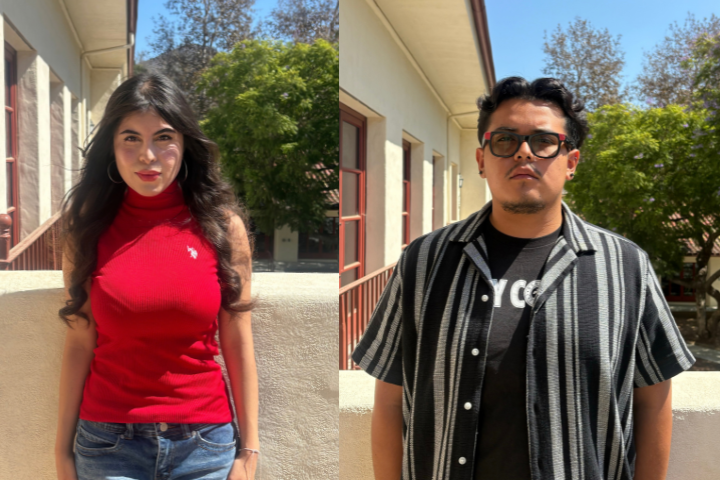
(Left) Estephania Mendoza, a junior transfer student majoring in early childhood studies and history
(Right) Sergio Gonzalez, a senior English major
Photos by Esmeralda Meckler
Q: What was the biggest challenge you faced when you first started college? How did you navigate that?
Gonzalez: One of my biggest challenges was learning how to navigate the college system on my own. In high school, it felt like I had bumpers in bowling, but in college, those bumpers were completely taken away. I had to figure out things like applying, enrolling, financial aid and all the paperwork without much guidance from my family. I mostly had to seek out information and figure things out myself. In hindsight, it wasn’t impossible, but doing everything for the first time made it feel impossible.
Mendoza: The biggest challenge I faced when first starting college was adjusting to the changing expectations. First, I transferred from community college, which in itself had its difficulties, I was overwhelmed by the vast number of programs and protocols. Then the time for applying to CI came and I recall how intimidating a process that was. Once the fall semester began, I realized how different the expectations for a university are. I’ve survived my first all-nighter, learned how to communicate with people and established my own rhythm for keeping up with all my work.
Q: Have you ever felt pressure to succeed? If so, how did that affect you?
Gonzalez: Definitely. The pressure comes from both my family and myself. It makes me feel like if I’m not actively working toward one of my goals, I’m failing. Even if I’m standing still, it feels like I’m moving backward. To me, success depends on whatever my current goal is, whether that’s getting through a semester with a certain GPA, passing a summer class or, in the long term, earning my bachelor’s degree and applying to graduate school.
Mendoza: Yes, I have felt pressure to succeed. Not only is this pressure rooted in making my family proud, but also in how far I tend to push myself. I put a lot of pressure on myself, maybe too much and it tends to exhaust me. While the success I’ve found this semester so far has felt great, the pressure of avoiding failure has proved excessive on my mental health. However, I am learning balance. Prioritizing mental health is as important as success.
Q: Who has been your biggest support during your college journey?
Gonzalez: My biggest support has been my immediate family. Even though they didn’t attend college and don’t always understand what I’m talking about, they still try their best to understand and accommodate me. If I need to work, attend an internship or focus on school, they respect that and adjust around me. Emotionally, that means the world to me because they’ve supported me even when they don’t fully understand what I’m going through.
Mendoza: My family has been my biggest source of support during my college journey. When I need to escape my dorm after hours of work or when I need a weekend to forget a week of scholarly articles and lectures, my family is always there to welcome me with open arms. They give me everything I could ever need. My family understands when it’s time to give me space for work or when I need a pick-me-up. It is now week six of my first semester of university and I don’t think I could have ever made it with so much enthusiasm and willpower if not for my family.

Bell Tower and Central Mall Fountain on CI’s campus
Photo by Chelsea Grandpre
Q: Are there any resources CI has that helped you or made you feel supported? If not, what can they do to improve?
Gonzalez: When I first transferred to CI during my junior year, I was assigned a mentor through the English program, which was an English faculty member. My mentor was Professor Ruvalcaba, it was helpful having someone I could talk to outside of the classroom and look to for academic guidance. The cultural centers have also been a big source of support. Last semester, I had long gaps between classes and the cultural centers gave me a quiet and comfortable place to be on campus when I didn’t want to stay in the library.
Mendoza: There are so many CI resources that have supported me so far. Now that I understand the importance of taking advantage of campus resources, I’ve done so every change I get. I have used library database sessions for help with writing research papers, my professors’ office hours, the Writing and Multiliteracy Center, the IT help desk, the CalFresh office and the Trio SSS program. CI’s Trio SSS program is one I encourage every undergraduate first-gen student to apply for, since its entire premise is to make you feel supported on your path to graduation.
Q: If you could give a piece of advice to a first-generation college student who is feeling lost, what would you tell them?
Gonzalez: Just do it. Do it if you’re scared, nervous or embarrassed. Do it even if you don’t think you’ll do it well. Just put yourself out there and try.
Mendoza: Put yourself out there, take advantage of every resource, attend events, meet people, ask questions. The biggest mistake you could make is letting your time as a first-generation student pass you by without leveraging opportunities and then realizing after graduation that you could have depended on professors, peers and events. Your voice is your strongest weapon; please utilize it.
As the series concludes, I hope these stories have helped readers feel seen, inspired and reminded that they are not alone on their journeys. Being a first-generation college student comes with unique challenges, but it also comes with the opportunity to create new paths for ourselves and those who come after us. Most importantly, I hope these stories reach another first-generation student who may be struggling to find their way and remind them that they belong here, their hard work matters and they are capable of achieving their goals.
