
Photo by Madelaine Brown
Written by Steven Mynott
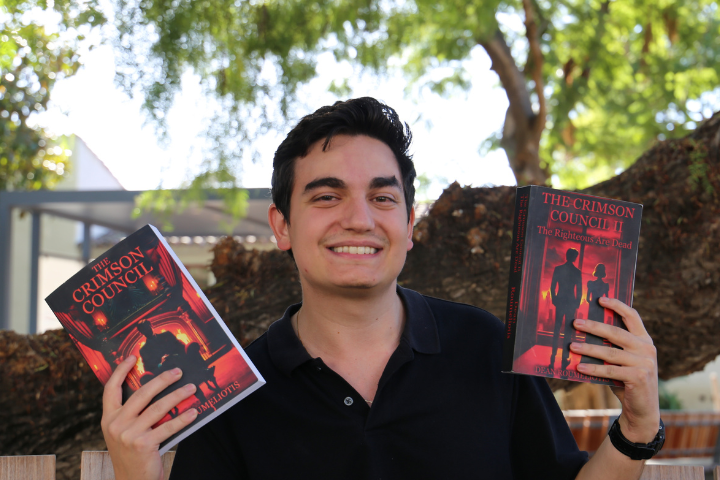
Did you know that CI has a published author as part of our student body? Dean Roumeliotis, a senior majoring in English, is the author of “The Crimson Council” and its sequel “The Crimson Council 2: The Righteous Are Dead.” In his own words they are “two novels about this guy who becomes a vampire, but he’s a really good person. So he doesn’t really want to be a vampire, and he struggles a lot with it, … kind of basically just exploring the morality of being a vampire and that it would actually kind of suck to be one. It kind of de-romanticizes a lot. … It’s the teen vampire romance thing as well.” Then he added with a laugh: “I swear it’s not ‘Twilight.’” Roumeliotis agreed to sit down and talk about writing and what it was like to get his work published.
Roumeliotis started writing fiction as a creative outlet when he was 16. He told me, “I guess it was like a song in my heart to sing. … I just like it, you know. I always kind of had stories in my head, and then I just decided, like, shouldn’t I just try to write them?” At the time he was inspired to start writing by Rick Riordon, author of the “Percy Jackson” series. These days, he finds inspiration in contemporary fantasy authors like Brandon Sanderson, best known for writing “The Stormlight Archive” and “Mistborn” series, and George R. R. Martin, author of the “A Song of Ice and Fire” series, also known as “A Game of Thrones.”
For Roumeliotis, the most rewarding part of writing a novel is “when you get the book in your hand, that was like one of the best feelings I ever had was when I first wrote my first book and just being able to feel it, you know?” he said. “Just to be able to look at it and it’s got your name on it, you know? And you know that every word that went in there, good or bad, came right out of you.” However, writing is not without its challenges. “For me, honestly, I would say just starting out is really hard. I really don’t like doing first drafts,” said Roumeliotis. “I mean, it takes me a long time to revise, but I think the revision process is a lot better in my opinion.”
His first novel took him about eight months to write, roughly half of which was spent writing the first draft and the other half on revising. He said that his “general goal for writing a book is about a year per book. And these are like novel size, around 180,000 word novels.” When I asked him if writing his second novel went faster than his first, he said, “… honestly, no, you become way more competent after writing one book, right? Every book you write will make you better. The problem is, is that your standards will get higher, and the level of quality that you’re looking for, the effort they need to put in to satisfy yourself, is a lot higher for each novel that I’ve done so far,” said Roumeliotis. “I think it’s just less mentally taxing. …”
Next, we pivoted to talking about the publication process. Roumeliotis self-published his novels on Amazon. “I would recommend to people who want to do self-publishing that you definitely can do it and Amazon’s a really good option. It’s just really hard and you have to put a lot of effort into it if you actually want to be a thing,” said Roumeliotis. “I don’t do any marketing or anything like that.” He admitted that he did use AI to create the cover images for his books because a good cover artist is expensive, and his books are a little rough to read because he could not afford an editor either. Amazon will create a table of contents and a copyright page for self published authors, but “you have to market it, which is really hard to do.” The advantage of self-publishing is that “It’s easier to … just get your book out on the market,” but “it’s harder to sell. It’s harder to make money.”
In the future, Roumeliotis says that he is going to pull his novels off of Amazon and “try to get traditionally published, which is a much more arduous process, but in my opinion, the path I want to take.” The advantage is that “the publisher, if you get traditionally published, will do basically everything for you when it comes to, like, marketing and selling the book,” he said. “All that stuff is handled not by you. All you’re doing is working with your editor to get a product out on a certain deadline that they want.” A good editor is key: “I would say that no good writer doesn’t have an editor. … Stephen King would not be a good author if he didn’t have a really good editor on his side, you know?” Having a support system is one of the biggest advantages of being traditionally published. “Otherwise, if you do self-publish, you have to buy that yourself. Basically, you have to invest in your own book, which is a scary and difficult thing to do.”
Finally, I asked Roumeliotis how he saw his future as a writer. “I mean, there’s a very optimistic, and then there’s a … perhaps more realistic, but the goal at some point … is to simply be able to support myself off of just writing books,” he said. “I don’t need a ton of money. I just need enough cash to, like, live. And if I can do that, I would be a happy guy. … I think I have the talent and the drive, the motivation to be a real full-time author. It’s just the breaking in, getting myself out there, becoming popular, those are all things that will, It’s all a gamble, really” What he can do, he said, is “keep writing for as long as I can. … However things are gonna shake out with me getting published and stuff, that’s all up to chance. So I hope to get published traditionally and to make a modest living and that’s really all I can expect.”
Before we concluded our conversation, Roumeliotis wanted to share some words of encouragement for other artists. “Everyone has that fire in them to do something. Whether that’s writing or something else, I just really encourage people to meet their full potential because I think art is important, and I think that everyone is an artist to some degree,” he said. “I mean, I was a terrible writer when I first started out. I think I’m a little better now, but it took me a long-ass time to get there, you know? I’m 22 now. I wrote two books, you know? I’m still not even that good. But I’m a lot better than where I started. I can very much see that. I could be proud of that, but it was very discouraging at first. Like just reading my stuff and realizing this is broken, like, mechanically. But I just kept going, and that’s all you can really do is just be consistent. As long as you keep going, you will eventually, you know, you’ll do great. And who knows, maybe you’ll be one of the greats someday, right? A legend. Just always keep going. Never stop. That’s my big thing.”
