
By Melisa Rodriguez
Graphic By Maya Uribe
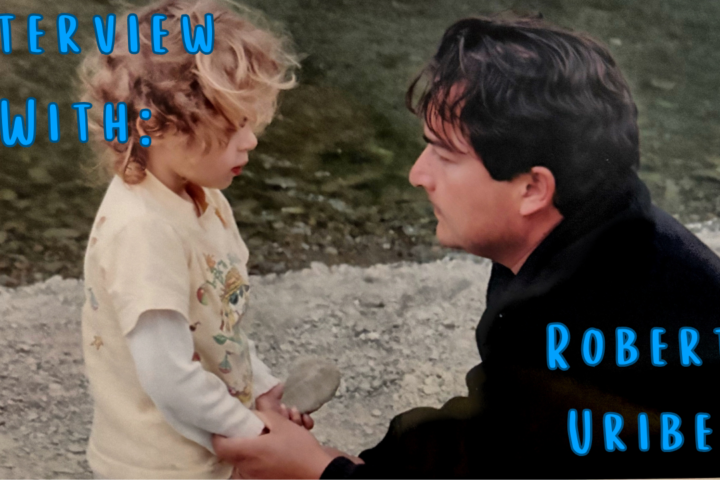
In an interview with Robert Uribe, self-published author, he shared insights into his journey as a writer, the influences that have shaped his style, and his passion for storytelling that reflects both personal experiences and a broader social consciousness.
Uribe’s writing journey began in high school, sparked by the music he was listening to. “Listening to music lyrics is what really kind of inspired me to start writing,” he said. Bands like U2, Duran Duran, The Cure and Thompson Twins were the catalysts for his early work. “The second book I ever read was ‘The Martian Chronicles’…Ray Bradbury has a very descriptive way of writing,” he continued, describing how Bradbury’s writing fueled his desire to write in a similarly vivid, engaging style.
In college, Uribe’s passion for writing deepened as he worked on the school newspaper, which led him to discover Ernest Hemingway. “I really liked his style, which was very short sentences and very concise ideas,” he reflected. This minimalist approach influenced Uribe’s own writing, as he aimed for “compact” narratives while incorporating descriptive elements. He strives to combine the shortness of Hemingway with the flowery descriptiveness of Bradbury. One particular passage from ‘The Martian Chronicles’ illustrates, “in fire light vapors dance,” left a lasting impact, showing Uribe the power of brief yet vivid storytelling.
When asked about the greatest influences on his writing style, Uribe named Hemingway, Bradbury and Arthur C. Clarke. “Arthur C. Clarke would be the big stories which is what I am trying to do,” he said. These authors have shaped his own writing philosophy, especially in his current project, ‘Seven Days in Spain.’
‘Seven Days in Spain’ represents the first book in the trilogy, a blend of contemporary fiction and science fiction. “It’s more of a father and daughter story with hints of a science fiction element,” Uribe explained. He also hinted at how future books in the trilogy will gradually shift toward a more pronounced science fiction narrative. “By the end of the trilogy, everything will be explained,” he teased, highlighting his aim for a satisfying, complete story that leaves readers with no questions about what happens next.
Uribe also integrates personal experiences and values into his stories. “Everything that I’ve ever written—short stories or ‘A Name for a Girl’ or ‘Seven Days in Spain’—are all based on things that actually happened,” he explained. While ‘A Name for a Girl’ is a more memoir-like piece, written for his daughter Maya Uribe, ‘Seven Days in Spain’ is 90% based on real events, albeit with fictional elements. His stories, he said, are driven by the hope that readers will become more conscious of their environment, politics and social injustices. “I try not to be preachy,” he clarified, “but just be more aware of injustice.”
In discussing the inspiration behind ‘A Name for a Girl,’ Uribe noted how he wove historical events into the narrative. “I was trying to give Maya a sense of what was happening at the time…it’s important to know these things.” This desire to blend personal storytelling with larger societal themes reflects his overarching purpose as a writer.
Uribe’s memoir project also had a profound effect on his creative output. “Writing the memoir is what kind of started it all,” he said, sharing how the birth of his daughter Maya reignited his passion for writing. The process led him to polish his earlier work and eventually led to his current project, The Division Trilogy, which has been 25 years in the making.
Through his work, Uribe’s hope is clear: to create stories that blend personal reflection, social awareness and a clear narrative arc, all while honoring his inspirations and creative vision. “I’ve always wanted to read a story that leaves you not asking what happens next,” he said, inviting readers to join him on a journey where the answers unfold naturally.
