
By Kevin Fox
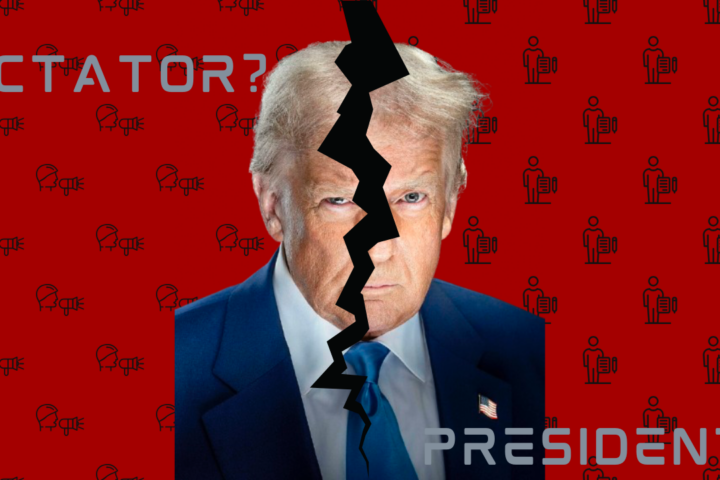
Graphic By Maya Uribe
On Jan. 20, 2025, President Donald Trump commenced his second term by signing a series of executive orders that many critics argue represent a direct assault on marginalized communities, environmental protections and global cooperation. These actions, far from promoting unity or progress, are seen as regressive measures that prioritize divisive ideologies over the well-being of the nation.
Withdrawal from the Paris Climate Agreement and Alaska Oil Drilling
In a move that stunned the world, Trump began the process of withdrawing the United States from the Paris Climate Agreement. The Paris Climate Agreement was a deal made in 2015 that nearly 200 countries signed on to that its main goal was to keep the global temperature below 3.6 degrees fahrenheit above pre-industrial temperatures. “It was as shameful a moment as any in our recent history: the country that produces more carbon than any other announcing that it was now the only country on earth not willing to make even a modest international commitment to solving climate change,” said Bill McKibben, founder of 350.org. The 350 organization is a non governmental organization that is part of a “campaign to keep fossil fuels in the ground and accelerate the renewable energy transition in an effort to tackle the climate crisis” according to their website 350.org.
Adding to the environmental devastation, Trump signed an executive order opening up vast swaths of Alaska, including parts of the Arctic National Wildlife Refuge, for oil drilling. He declared an “energy crisis,” framing the move as a necessity for achieving American energy independence. Environmental groups decried this as a giveaway to fossil fuel companies that would destroy pristine ecosystems and accelerate climate change.
The Sunrise Movement, an environmental activism organization, had this to say about the slough of executive orders that came in on Trump’s first day in office on X, “ On Day 1, Trump is enacting executive orders that hand billions to fossil fuel billionaires, dismantle green energy initiatives and scapegoat marginalized communities. Trump’s actions make it clear whose side he’s on: the powerful and wealthy who bankrolled his campaign.”
“Severe climate shocks threaten to roll back decades of progress against poverty,” said World Bank Group President Jim Yong Kim. “Storms, floods and droughts have dire human and economic consequences, with poor people often paying the heaviest price. Building resilience to disasters not only makes economic sense, it is a moral imperative.
The consequences of these decisions are already being felt across the United States, particularly in regions like western North Carolina and Southern California. The areas have faced an unprecedented onslaught of climate disasters, including stronger and more frequent hurricanes, devastating floods and massive wildfires fueled by drought and warmer conditions. “We’re seeing the fingerprints of climate change everywhere,” said Dr. Katharine Hayhoe, a leading climate scientist.
For the first time in our nation’s history, we have a president and a political party openly threatening to block disaster relief to a state that has suffered a catastrophe of this magnitude—not out of concern for recovery efforts, but as a means to extract unrelated political concessions. The Trump administration is leveraging federal aid as a bargaining chip, demanding changes such as stricter voter ID laws in exchange for assistance that should be given without condition. This tactic turns disaster relief into a tool for partisan gain, putting communities in crisis at risk for the sake of political maneuvering.
In stark contrast, the Biden administration has responded swiftly and decisively to recent natural disasters, including the devastating floods in North Carolina. Without attaching political strings, Biden declared a state of emergency and authorized federal aid to assist affected residents, ensuring that relief reached those in need as quickly as possible.
Deployment of Troops to the U.S.-Mexico Border and Classifying Cartels as Terrorist Groups
In a display of militarized xenophobia, an executive order authorized the deployment of U.S. troops to the southern border, framing immigration as an existential threat. This action escalates tensions and diverts military resources from genuine security concerns. The order also designated international cartels and crime organizations as terrorist groups, a move critics argue is a simplistic “solution” to complex issues.
Trump had this to say about the cartels, “The drug cartels are waging war on America—and it’s now time for America to wage war on the cartels. When I am back in the White House, the drug kingpins and vicious traffickers will never sleep soundly again.”
While Trump’s Secretary of Defense was quoted as saying this: “If it takes military action, that’s what it may take, eventually,” said Hegseth. “Obviously, you’re gonna have to be smart about it. Obviously, the precision strikes. But if you put the fear in the minds of the drug lords, at least as a start, [and] they can’t operate in the open with impunity, [it] changes the way they operate.”
In his role as the Trump administration’s “border czar,” Tom Homan has been instrumental in implementing aggressive immigration enforcement strategies, including the deployment of additional troops to the U.S.-Mexico border. In late January 2025, the administration deployed an additional 1,500 troops to the border to assist with constructing barriers aimed at preventing illegal crossings and trafficking. Homan has emphasized that all undocumented immigrants are potential targets for deportation, underscoring the administration’s commitment to stringent border security measures.
On January 29, 2025, President Donald Trump signed an executive order directing the expansion of the Migrant Operations Center at Guantánamo Bay to accommodate up to 30,000 individuals. This facility is intended to detain “high-priority criminal aliens” as part of the administration’s intensified immigration enforcement efforts that Homan has described as being for “only the worst of the worst.” Critics have condemned the move, likening the proposed facility to a concentration camp and expressing concerns over potential human rights violations.
These statements have sparked international outrage, with Mexican officials condemning the plans as a violation of their sovereignty. Mexican President Claudia Sheinbaum responded to the executed orders Tuesday, emphasizing that “we all want to fight the drug cartels.” However, she drew a clear line to do so: “The U.S. in their territory, us in our territory,” she added.
In a public letter dated January 26, 2025, Colombian President Gustavo Petro addressed the U.S. administration’s deportation practices, expressing profound concern over the treatment of Colombian nationals being repatriated. He emphasized that migrants are not criminals but individuals seeking better opportunities, and he condemned the use of military aircraft for deportations, asserting that such methods are dehumanizing and unacceptable. He also highlighted that none of the deported individuals had criminal records in either Colombia or the United States, challenging the narrative that associates deportation with criminality.
Pardoning January 6 Rioters: Releasing of the ‘Brown Shirts’
In an unprecedented move, Trump issued pardons or commutations to over 1,500 individuals convicted for their roles in the January 6 insurrection. Critics have condemned this decision as a brazen endorsement of political violence and an alarming signal to extremists.
Democrat Congressman Jamie Raskin described the January 6 riot as, “The attempted coup and insurrection left 150 law enforcement officers injured, wounded, traumatized or dead. Anyone who denies or minimizes this unprecedented assault on law enforcement can never call himself or herself ‘pro-law enforcement.’ That’s just political fraud.”
This change of policy marked a shift from the Trump administration’s earlier position; on January 26th, Vance had stated that while peaceful protesters might merit pardons, those who committed violence “obviously shouldn’t be pardoned.” The broad scope of the pardons, which included individuals convicted of assaulting police officers, has drawn criticism from various quarters, including some Republicans who argue that pardoning violent offenders sends the wrong message and could potentially incite further violence.
Video evidence and court filings have revealed chilling details of the insurrectionists’ intentions, including plans to take hostages and disrupt the certification of electoral votes. By granting clemency to these individuals, Trump has effectively legitimized their actions and emboldened future attempts to undermine democracy.
Raskin later added that the pardons would be an “extraordinary event in the history of the republic to have a president pardon more than 1,000 criminal convicts who were in jail for having engaged in a violent insurrection incited by that very president.” And that “as a reserve army of political foot soldiers to act on behalf of MAGA and Donald Trump?” Raskin told CNN’s Erin Burnett during an appearance on the network. “I think that’s what’s so profoundly troubling to a majority of the American people who rejected the idea of freeing at least the violent criminals and the ones who were convicted of seditious conspiracy, which means conspiracy to overthrow the government.”
Erasure of Transgender and Non-Binary Identities
One of the most alarming orders, titled “Defending Women from Gender Ideology Extremism and Restoring Biological Truth to the Federal Government,” mandates federal recognition of only two sexes—male and female—based solely on reproductive anatomy. This directive effectively erases the existence and rights of transgender and non-binary individuals, denying them access to appropriate facilities, healthcare and legal recognition. The American Medical Association and the American Psychiatric Association have long affirmed that gender is a spectrum, not a binary construct. By disregarding established medical consensus, this order not only undermines scientific integrity but also endangers the mental and physical health of countless Americans.
Reinstatement of the “Remain in Mexico” Policy
The revival of the “Remain in Mexico” policy forces asylum seekers to wait in dangerous conditions outside U.S. borders, violating international human rights standards. This policy has previously resulted in significant harm to vulnerable individuals fleeing persecution and its reinstatement reflects a callous indifference to human suffering.
Withdrawal from the World Health Organization
Adding to the environmental failures, Trump withdrew the U.S. from the WHO in the wake of a global pandemic. This decision, coupled with the rise of highly contagious diseases like Bird Flu, further erodes America’s ability to respond to international health crises. “The WHO can be improved; there are inefficiencies, like with all organizations,” says Paul Spiegel, professor in the department of international health and director of the Center for Humanitarian Health at the Johns Hopkins Bloomberg School of Public Health. “But by pulling out and removing the huge amount of money that the U.S. gives, you’re not allowing the WHO to make reforms. You’re hobbling it.”
Dismantling Diversity, Equity and Inclusion Programs
In a move that starkly contrasts with decades of progress toward social justice, another executive order terminates all federal Diversity, Equity and Inclusion (DEI) programs. The administration’s claim that these initiatives constitute “forced illegal and immoral discrimination programs” is a gross misrepresentation. DEI programs have been instrumental in addressing systemic inequalities and fostering inclusive environments within federal agencies. Abolishing these programs signals a troubling disregard for the ongoing struggles against racial and gender discrimination, effectively sanctioning a return to exclusionary practices.
Conclusion
President Trump’s inaugural executive orders of 2025 represent a profound step backward for the United States. By undermining the rights of marginalized communities, dismissing scientific consensus, and retreating from international cooperation, these actions betray the nation’s foundational principles of equality, justice, and progress. But beyond these ideological concerns, his policies are also directly harming everyday Americans. Despite campaign promises to lower prices and rein in inflation, his administration’s policies—such as tariffs that drive up costs, mass deportations that create labor shortages and cost absurd sums of money to conduct, and tax cuts that balloon the deficit—are only exacerbating economic instability. Instead of fulfilling his pledge to make life more affordable, Trump’s agenda is making it harder for working-class Americans to keep up. It is imperative for advocates, policymakers, and citizens to resist these regressive measures and continue striving toward a more inclusive, equitable, and economically stable society. One question that needs to be answered by every person is: does any of this, in any meaningful way, change your life for the better?
