
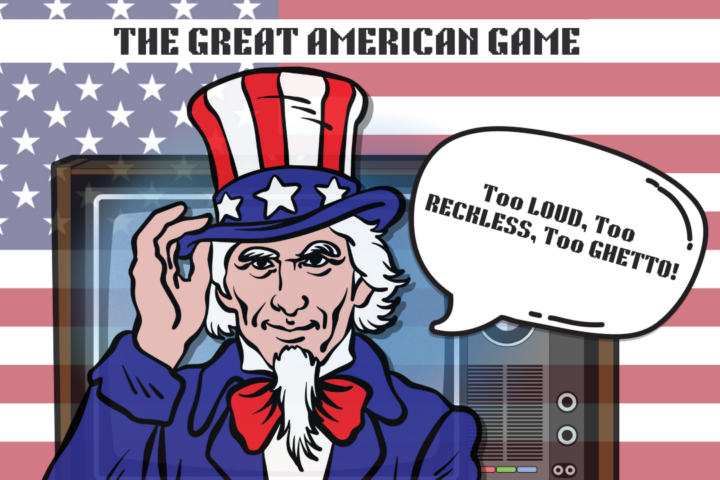
Graphic By Ashley Tolteca
By Miggy Aguilar
On Sunday Feb. 9, the words of rapper Kendrick Lamar’s performance this year’s 59 Super Bowl resounded beyond the walls of the Caesars Superdome in New Orleans, Louisiana and into the hearts and minds of the American people.
“The revolution will be televised, you picked the right time but the wrong guy,” Lamar boldly claimed before performing GNX, the titular song of his most recent critically acclaimed and Grammy award-winning hip-hop album. At face value and in the minds of many viewers, Lamar makes this statement in order to call attention to the current state of the world–riddled with social, economic and political issues that affect millions of people all while the United States faces these challenges at the whim of a seemingly unitary executive. However, the themes of this statement along with other theatrical dialogue provided by Oscar award-winning actor Samuel L. Jackson and an ensemble of dancers and Lamar’s contemporaries bring to mind a different message; Lamar’s plea with the viewer to think critically about the challenges facing our society.
That is to say that the “wrong guy” refers not only to the current executive branch, but also to himself and other prominent figures that frequently capture the public’s attention. It is the responsibility of each individual to act, hold power accountable and seek credible information about current events rather than relying on idols and existing structures to do so for them.
The basis for this interpretation of Lamar’s performance can be found no further than in his previous album, Mr. Morale in which he uses the track Savior in order to illustrate this point.
The opening lyrics of the song read,
“Kendrick made you think about it, but he is not your savior
Cole made you feel empowered, but he is not your savior
Future said, ‘Get a money counter’, but he is not your savior
‘Bron made you give his flowers, but he is not your savior
He is not your savior.”
Lamar proposes that high-achieving and well known minority figures may provide good examples of what constitutes meaningful engagement with certain issues, however ultimately it is each individual’s prerogative to apply these principles in their own lives.
Throughout his performance at this year’s Super Bowl this view is challenged by Jackson’s portrayal of Uncle Sam, an influential character in early American pop-culture. In response to Lamar’s performance of both GNX and Squabble Up (the second song in his setlist), Jackson’s Uncle Sam responds with a scathing “Too loud, too reckless, too ghetto. Mr. Lamar, do you really know how to play the game? Then tighten up!” This, of course, is in reference to Lamar’s willingness to bring attention to problems that have historically affected the black community in America with lines such as “40 acres and a mule, this is bigger than the music,” alluding to the promise made to formerly enslaved African Americans by Union general William Tecumseh Sherman and “They tried to rig the game but you can’t fake influence.” It is suggested that the expectation for minorities in America is not to act in ways that upset the status quo or too boldly display their culture, thus playing by the rules of the “Great American Game” that Jackson coins throughout the performance. These segments of Lamar’s performance instead call on minorities and the general public to approach issues with the assumption that people should not strictly abide by this expectation and that one’s actions can influence outcomes for groups of people beyond themselves.
The response of Jackson’s character to the tracks that Lamar performs with R&B singer SZA including songs like Luther and All the Stars proves that while they are incredibly meaningful and well-performed in their own right, they are calmer, more palatable, less socially charged and typically fly under the radar of Uncle Sam by remaining uncontroversial.
When contrasted with a track like Lamar’s magnum opus “Not Like Us,” which dedicates a whole verse to giving the audience a history lesson on the modern-day effects of slavery and the importance of cities such as Atlanta, Georgia with significant black diasporas that were the backbone of America’s early industries and rail systems, the message that Lamar wanted to send with this halftime show is clear: even when doing something as simple as consuming media like the Super Bowl, consider the context under which it is being delivered along with how it affects you and the communities you are a part of. Act thoughtfully, as no song or event in history exists isolated from the influence of the people who write them.
