
Graphic by Dani Ramirez
Written by Esmeralda Meckler
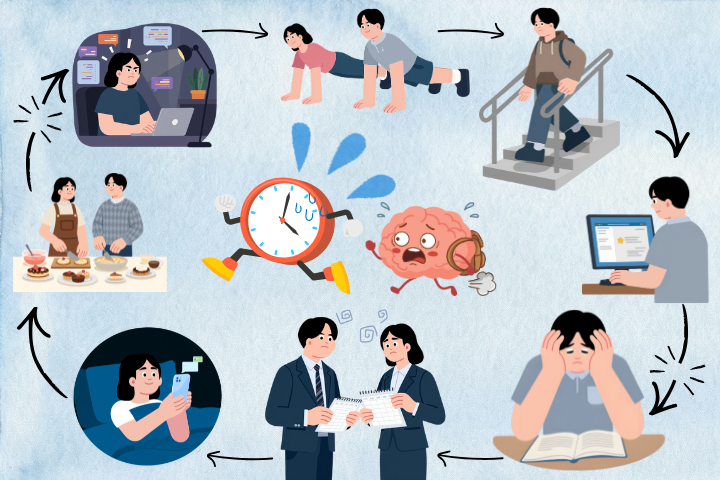
When daily routines fall apart, whether from a new class schedule, changing work hours or inconsistent sleep; the disruption can feel intense. Concentration declines, emotional responses intensify and even routine tasks demand greater effort.
Reaction is not just stress or laziness. It is the brain shifting gears. When those systems are disrupted, the brain must rely on more energy-demanding networks, triggering cognitive fatigue and emotional strain, but also creating an opening for learning and behavioral change.
How the brain builds routines
According to the National Institute of Mental Health, repeated behaviors can become automatic as the brain shifts control from conscious decision-making to habit-based neural pathways. These pathways allow routine actions to occur with little intentional thought, reducing the need for constant monitoring.
The National Institute of Mental Health explains that this automation lowers cognitive load, freeing mental resources for attention, learning and problem-solving. When routines remain stable, the brain operates more efficiently by relying on predictable patterns rather than active control. However, when a routine changes, automatic processing breaks down, requiring the brain to reengage conscious effort.
Why disruption drains mental energy
According to a 2020 review in Trends in Cognitive Sciences, adapting to change increases demands on the prefrontal cortex, the region responsible for attention, planning and decision-making. The problem, researchers note, is that the prefrontal cortex is particularly sensitive to stress and uncertainty. When routines break, stress hormones increase and control becomes less reliable.This helps explain why routine disruption often feels overwhelming even when the change is minor. The brain is suddenly doing more work with fewer resources.
Sleep deprivation changes everything
Changes that affect sleep schedules tend to intensify the effects of routine disruption. According to the National Institute of Mental Health, irregular circadian rhythms interfere with communication between brain regions involved in attention, emotional regulation and impulse control. Disrupted sleep patterns are consistently associated with reduced focus, poorer decision-making and increased emotional reactivity.
The Sleep Foundation, which summarizes research from sleep medicine and neuroscience, reports that circadian misalignment alters activity in the prefrontal cortex, the brain area responsible for planning, self-control, and cognitive flexibility. For college students, late nights, weekend schedule shifts, and inconsistent wake times can function as repeated neurological stressors, placing ongoing strain on cognitive and emotional systems.
Why disruption feels emotional
Routine disruption often shows up emotionally before it shows up cognitively. Students may feel anxious, irritable or unmotivated even when they cannot point to a clear problem. According to neuroscience research, that reaction reflects a shift in how the brain processes information. A 2019 study published in Neuroscience & Biobehavioral Reviews found that stress pushes the brain toward more reactive processing, prioritizing immediate responses over long-term planning. Under those conditions, emotional systems become more dominant while cognitive control weakens. This stress-related imbalance helps explain why disruptions to routine can feel personal or destabilizing even when the change is temporary or objectively manageable. The emotional response is not a misinterpretation of the situation but a predictable outcome of how the brain reallocates control when familiar patterns are interrupted.
At the same time, that emotional disruption can serve a purpose. According to a 2020 study in Behavioral Neuroscience, habits depend heavily on stable environmental cues. When those cues change, such as during a new semester, a move or a schedule shift; automatic behaviors become less dominant. Researchers found that disrupting familiar contexts weakens habitual responses and allows goal-directed decision-making to reengage. This is why people often find it easier to adopt new habits during periods of transition. The same disruption that creates emotional discomfort also loosens rigid behavior patterns, creating space for change.
Disruption is unavoidable
In moderation, routine disruption increases flexibility. It challenges the brain’s defaults, temporarily increases emotional sensitivity and opens a window for learning, even if the process feels uncomfortable in the moment.
Neuroscientists say routine disruption is unavoidable but manageable. Research shows that consistent sleep timing and a few stable daily anchors can help protect focus during change. Routines conserve mental energy, and when they break, discomfort is not failure, it is adaptation.
