
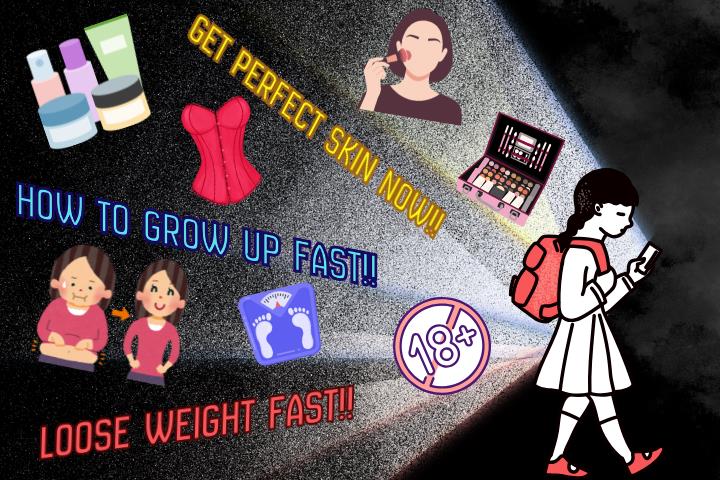
Graphic by Dani Ramirez
Written by Timothy Walker
In my Children’s Literature class, we recently finished reading “A Wrinkle in Time” by Madeleine L’Engle. The novel follows three children and three supportive star-born guardian figures on a journey to rescue their scientist father from IT, a cold, centralized intelligence that controls minds by eliminating emotion, individuality and independent thought. At its core, the story is an affirmation of love, imagination, and moral courage in the face of mechanical conformity.
Love in “A Wrinkle in Time” is presented as unconditional and non-performative. Meg Murry’s stubbornness, impulsivity, and emotional honesty are not weaknesses but strengths that allow her to reach her brother Charles Wallace when logic and force fail.
A hearty tale, doused in Christian (Episcopalian) universalist ethics, where love exists for its own sake rather than as something to be managed, optimized, or performed. This understanding of childhood as messy, morally serious, and fundamentally human feels very distant from our media today. Today, love is framed as strategy.
The Hunger Games is a clear example of this as Katniss Everdeen utilizes her display of affection for Peeta Mellark in order to survive. Her relationship is monitored by drones, broadcast to mass audiences, and shaped by political necessity. Privacy is nearly nonexistent. Intimacy becomes a spectacle.
A calculated tale, shaped by social Darwinist and utilitarian logic, where love primarily functions as strategy, currency, and spectacle rather than as moral commitment. Punished authenticity rewards curated emotion resulting in love’s inability to remain organic.
It instead must be optimized. So Katniss hardens. She matures. Yet she remains inexperienced and young, illustrating a tragedy of systemic adultification, a process in which children are perceived and treated as more mature, responsible and emotionally resilient than they actually are. Psychologists Phillip Atiba Goff and Matthew Jackson describe this as “adultification bias,” the tendency to view children as less innocent and more adultlike than their peers.
Scroll through Instagram or TikTok and children act as content producers for an attention economy. They spend hours curating appearance, rehearsing reactions and managing engagement. Whether through beauty products, parental monetization, or algorithmic trends, young people are increasingly trained to treat themselves as marketable brands bleeding from online to an in-person sociability crisis.
Financial and social incentives reward self-manipulation. The result is a culture of fake enthusiasm, real insecurity, and constant self-surveillance within a hyperreal digital environment.
Children are not growing up faster by accident. They are growing up because they are being trained to adapt their humanity to machines we designed.
The rise of early beauty labor: “Sephora Kids”
Adultification begins with appearance. Researchers in Pediatric Dermatology warn that the increasing use of skincare products among children poses real physical dangers, while also intensifying unrealistic beauty ideals and social pressure. Social media has expanded opportunities for constant comparison beyond one’s immediate peer group, exposing young users to highly edited images and subtle advertising that distort reality and undermine self-esteem.
Many of these products are not even designed for developing skin. Researchers note these products are intended for adults, with risks for children ranging from irritation to chemical burns and permanent scarring. These dangers are compounded by a global market that promotes skin-lightening and “perfecting” products to young consumers, reinforcing colorist standards while exposing children to harmful chemicals.
Mainstream media further normalizes this pressure. A USA Today report describes how “get-ready-with-me” videos and “Sephora kid” content saturate platforms like TikTok, while warning that the “dangerous influence” of eating disorder–adjacent trends and the “return of the ultra-thin body standards” continues to shape youth culture. From face-slimming wraps to Ozempic-driven transformations and restrictive “girl dinner” aesthetics, children and adolescents are surrounded by messages that frame body manipulation as self-improvement.
Together, these practices normalize the idea that children’s bodies require constant correction and beautification as a precedent to finding confidence and acceptance from within their skin.
Influencer culture and monetized childhood
As appearance becomes detrimentally central to childhood, visibility acts as currency. An Ad Age report on child influencers notes that young creators with large followings can earn thousands of dollars per sponsored post, with some becoming multimillion-dollar brands before reaching adolescence.
These children are not merely sharing their interests online but operate within a commercial system that rewards constant performance, brand alignment, and audience growth. Their personalities, hobbies, and relationships have transformed into marketable assets.
This economic pressure reshapes how childhood is experienced. When attention determines income, authenticity becomes risky and mistakes become costly. Posts must be polished, reactions rehearsed and identities carefully managed to maintain engagement. Parents and sponsors often function as informal managers, negotiating contracts and monitoring public image.
In this environment, growing up is no longer a private developmental process. It is a public performance evaluated in real time by algorithms and audiences. Childhood is labor, and maturity becomes a professional requirement rather than a natural outcome of experience.
Age compression and sexualized presentation
This transformation is not a random result. Media researchers Ashton Speno and Jennifer Aubrey describe the process as “age compression,” a system in which girls are routinely “dressed up” to look like women, while women are simultaneously styled to appear younger. In their analysis of popular magazines, Speno and Aubrey found that adultified girls were significantly more likely to be portrayed in provocative clothing and sexualized poses, reinforcing the idea that social value is tied to desirability rather than development.
This process aligns with the American Psychological Association’s definition of sexualization, which includes the “inappropriate imposition of sexuality” on young people.
When children are presented as miniature adults, they are taught that maturity means appearing attractive, composed, and emotionally restrained. Vulnerability, awkwardness, and experimentation are central elements of healthy developmental stages of growth but are rather framed as weaknesses.
Age compression is further reinforced through marketing practices that promote adult products to children in order to establish early brand loyalty. Beauty routines, fashion trends and lifestyle aesthetics are introduced years before adolescents are equipped to interpret them critically. As a result, childhood has been compressed into a narrow window between dependency and performance, leaving little space for gradual psychological and emotional maturation.
Self-objectification and psychological internalization
Repeated exposure to idealized and sexualized imagery does not remain external. It becomes internalized. Jolien Trekels and Steven Eggermont describe this process as the adoption of an “observer’s perspective” on the self, in which adolescents learn to evaluate their bodies as objects to be viewed and judged, rather than as lived experiences.
Through constant engagement with appearance-focused content, young people begin to prioritize how they look over how they feel, think, or act.
Social media intensifies this process by encouraging comparison and internalization. Nikol Kvardova and colleagues note that adolescents regularly encounter highly idealized images that are carefully edited and selectively presented, reinforcing narrow standards of attractiveness.
As these standards are internalized, appearance becomes a personal benchmark for self-worth. Children are no longer simply exposed to beauty ideals; they adopt them as personal goals.
This internalization carries serious psychological consequences. Metin Çınaroğlu and Eda Yılmazer found that self-objectification mediates the relationship between social media use and body image disturbance, contributing to increased anxiety, depression and dissatisfaction. When children learn to monitor and evaluate themselves through an external lens, they become trapped in cycles of self-surveillance and self-criticism.
Identity becomes fragile when dependent on approval, metrics and visual validation.
Under these conditions, adultification is no longer imposed solely from the outside. It becomes self-enforced. Children learn to discipline their own bodies, emotions, and expressions in order to remain visible, desirable, and competitive within digital and social spaces.
Do not settle
In “A Wrinkle in Time,” Meg saves her brother not by perfecting herself, but by refusing to. Her flaws, emotions and inconsistencies are treated as sources of strength rather than liabilities. She is allowed to be incomplete. She is allowed to be human. That permission is what ultimately resists IT’s demand for conformity.
Contemporary childhood offers far fewer such protections. From beauty labor and influencer economies to sexualized representation and self-objectification, young people are increasingly taught that value must be earned through visibility and performance. The result is not maturity, but exhaustion.
This is not a story about children failing to grow up “properly.” It is a story about systems that refuse to let them grow up slowly. When childhood is reorganized around markets, metrics and mediated approval, emotional development becomes secondary to manageability.
Young people learn to regulate themselves before they learn to understand themselves.
No single brain controls childhood. Instead, it is governed by networks, algorithms, and industries that reward conformity and punish vulnerability.
The effect, however, is strikingly similar.
If childhood once functioned as a space for uncertainty, play and moral experimentation it is now increasingly treated as a training ground for an attention economy.
The question is no longer whether kids are growing up too fast but whether we have built a culture that allows them to grow up at all.
