
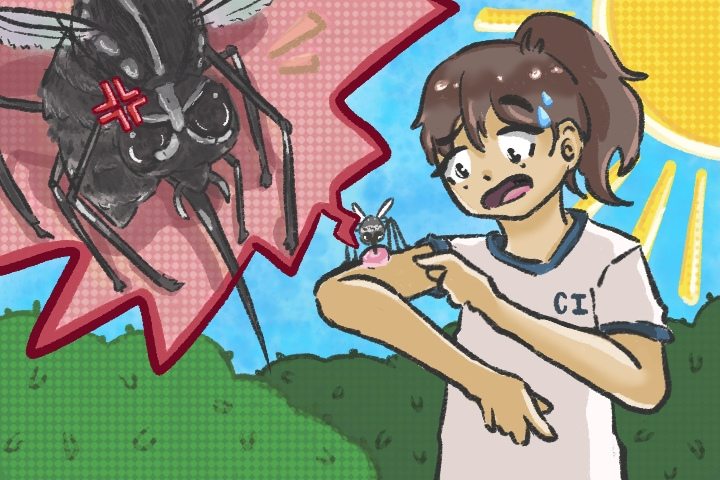
Girl being bitten by a bloodthirsty mosquito
Graphic by Dani Ramirez
By Dani Ramirez
Itching to know why so many mosquitoes have been on campus lately? CI covers more than 1.3 million square feet of land, yet these tiny insects still find their way to the arms and legs of those on CI’s campus. This raises questions of whether or not there are safe spots on campus to escape these invasive insects and how students should avoid getting bitten. This article discusses how and what kinds of mosquitoes are on campus, what precautions are being taken, tips for prevention of bites and an interview with CI’s Director of Environmental Health and Safety. Will students be stuck spraying their entire wardrobe with DEET, or is there a better solution?
What is bringing mosquitoes to campus?
According to a webpage titled “Mosquitoes” on the Cal State Channel Islands Environmental Health & Safety and Risk Management website, the University is adjacent to many bodies of water, 1,800 acres total, including Mugu Lagoon, Calleguas Creek and CI Regional Park, creating the ideal breeding grounds for mosquitoes. The mosquitoes seen on campus are almost always from these off-campus breeding sites. However, areas with still standing water or sheltered vegetation on campus can also shelter these mosquitoes.
The Therapy Garden across from Anacapa Village C, the water fountains alongside the old courthouse building across Santa Rosa Village and the fountain inside the abandoned courtyard next to Lindero Hall are more likely to be mosquito hotspots due to the still water and vegetation. For students, being aware of these spots can make it easier to take precautions and avoid unwanted bites.
The recent heat wave is also a contributing factor in the increase of mosquitoes on campus. In an article by Zach Boetto, a CBS News reporter, vector control expert Brian Reisinger mentioned how the recent hot temperatures have increased food sources and sped up maturity for mosquitoes. “It’s actually increasing the production of the young ones. So, for every adult that dies, you might get 10 or 20 newly hatched.” Reisinger said. “As this heat wave goes on, we’re definitely going to see more and more mosquitoes.”
What mosquito species are on campus?
On campus, there are two types of mosquitoes: saltmarsh mosquitoes and night-biting mosquitoes. The CI Health & Safety and Risk Management’s “Mosquitoes” webpage states that the saltmarsh mosquitoes breed in saltwater ponds left in coastal wetlands and appear in large numbers on campus after high tide events. The webpage also stated, “they are very aggressive ‘day-biters’ and account for nearly all daytime mosquito bites here on campus. There is little evidence that this type of mosquito transmits diseases.” To avoid being bitten by these day-biters, students should be cautious when going outside during elevated temperatures or humidity during mosquito season, which happens from late spring through early fall. According to Agricultural Pest Control Services, peak mosquito season is between July and August.
Night-biting mosquitoes, such as the Culex and Aedes species, are known to carry diseases, including the West Nile virus, and breed in fresh and stagnant water. According to the U.S. Centers for Disease Control and Prevention (CDC), Culex mosquitoes are found in low-lying pastures, agricultural areas and sometimes water-filled buckets, birdbaths or flowerpots. While this species of mosquito is less likely to bite you on campus, the CDC advises to watch for symptoms of the disease such as fever, headaches, rashes or other symptoms.
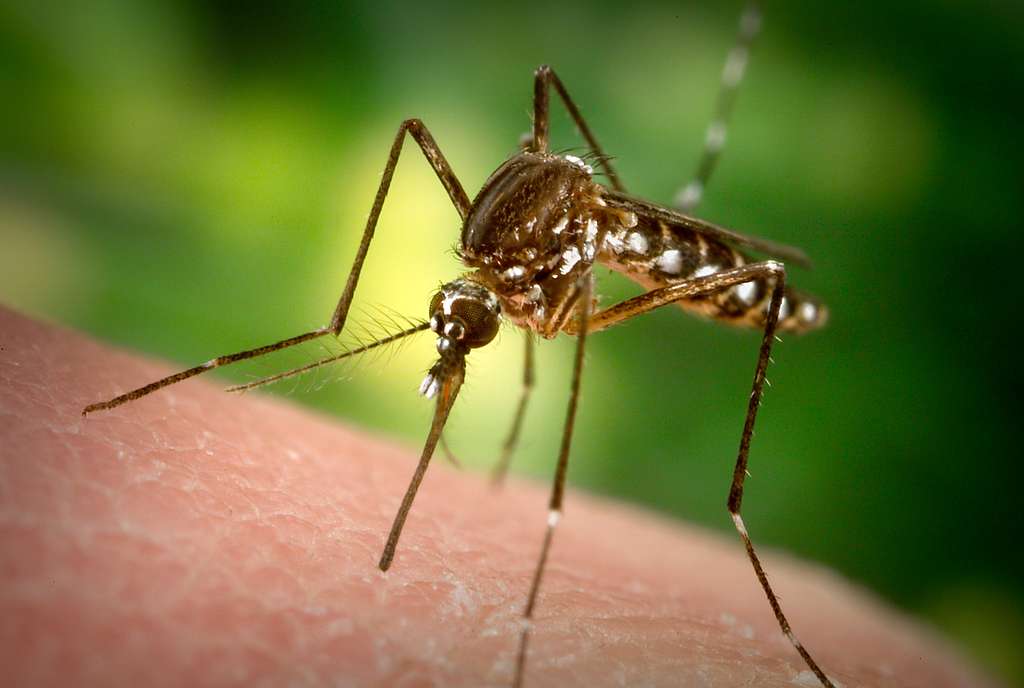
A female Aedes aegypti mosquito in the process of inserting her fascicle through the surface of the host’s skin
Photo courtesy of cdc.gov
What solutions does CI provide?
CI published an update to the “Methods of Control and Health Risks” webpage regarding mosquito prevention on their website. While there is no written date on the article, it stated that “black light mosquito zappers have been installed in the south quad and around the campus in 15 different locations to help mitigate the influx of mosquitoes we are expecting this summer, due to unseasonal rains this year.” As part of the University’s pest control company services, the facilities services on campus also receive a mosquito baiting program.
Along with black light mosquito zappers, the “Methods of Control and Health Risks” webpage stated, “the campus has a staff member who is licensed and certified for application of pesticides; this capability provides us a way to reduce the population of mosquitoes in landscaping and around building exteriors.” CI has also used mosquito bait traps in areas that are known to have standing water; however, this is only a temporary fix that works in limited areas. “Traps can attract more mosquitoes, residual poisons can adversely affect both humans and wildlife, indoor use of pesticides or repellents can create poor indoor air quality,” the article informed. CI evaluates options for control that optimize the health and well-being of the community.
As for controlling the mosquitoes outside of campus, the article mentioned that The Naval Base Ventura County (NBVC) Point Mugu and the County of Ventura (VEN), “utilize these larval stage controls as well as surveillance, source reduction and a variety of adult mosquito control strategies.” In the local marshes, the NBVC is also said to perform ground-based larval control, ground-based fogging to kill adults, and spraying residual contact poisons on plants and structures. Freshwater ponds, lakes and ditches surrounding campus are under the authority of the Ventura County Vector Control Program, the article explained. VEN uses mosquito bacterial pathogens and slow-release pesticide briquettes as one of the techniques to control mosquitoes during their developmental stages, treating the standing water sources at least monthly.
Dragonflies have been spotted flying around campus and for CI students, this is a relief because dragonflies are known predators of mosquitoes. In an article for ABC News by Olga R. Rodriguez, Chris Grinter, a Senior Collection Manager of Entomology at the California Academy of Science in San Francisco, mentioned that dragonflies are voracious predators that are feeding on mosquitoes nonstop. “They can eat hundreds of mosquitoes a single day,” Grinter said. While the water on and surrounding campus attracts the insects we are hoping to get rid of, it also brings in the solution, as dragonflies are a natural way of getting rid of mosquitoes.
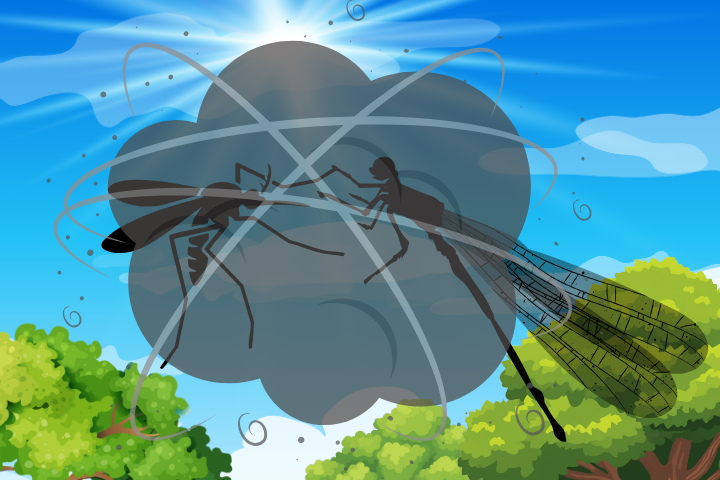
A mosquito and dragonfly battle it out on a summer day
Graphic by Dani Ramirez
Interview with CI’s Director of Environmental Health & Safety
Joyce Spencer, CI’s Director of Environmental Health & Safety, shared some information regarding the mosquitoes on campus and some contacts that will be helpful to students who want to keep their dorm rooms free from pests. Regarding the update to the Methods of Control and Health Risks article about mosquito prevention, Spencer had informed me that the latest update about the black light mosquito zappers happened sometime last year and that they are managed by the Grounds Department on campus. Due to the Grounds Department being the ones to manage the zappers, Spencer was unable to provide information on whether they were still up and working in the 15 locations.
When asked what other methods CI uses to eliminate mosquitoes that were not mentioned in the article, she said “[we] also use mosquito dunks, which are these things that you can put in any standing water that we have that would kill off the mosquito larvae. [We] work with Ventura County and they do monitoring on our campus as well.” CI is contracted with a pest company that will come and spray the bushes as well as around buildings. “There’s not a whole lot they can do, but they can do some spraying of the bushes and try to kind of reduce the numbers,” she said, “it really is just dependent on how bad the influx is, is the weather and then also what’s happening in the marshes.” Spencer mentioned that the one area on campus not sprayed by pesticides, to her knowledge, was the Therapy Garden across Anacapa Village C.
The wind is also a factor in the amount of mosquitoes students have spotted on campus. Although unable to fly far distances, saltmarsh mosquitoes can easily make it to campus and even further distances with the help of the wind, starting at the NBVC Point Mugu and traveling as far as Newbury Park, California. Sometime during the year, grounds personnel will perform inspections around CI in search of standing water, places that may need to be sprayed or places that were reported to them by students, staff, or faculty. “Typically, they’ll look at the most common areas which are drains and culverts and things like that,” Spencer mentioned. Students, if needed, are free to report any standing water sightings to the CI Facility Services Work Center, who are available by phone at 805-437-8461, Monday to Friday 7:00 a.m. to 4:00 p.m., or by email at fsworkcenter@csuci.edu. During mosquito season, if students’ window screens are damaged, they may put in a work order through the student work order system with Housing & Residential Education (HSE). “I know that the housing department has also worked to get like the floor sweeps on doors put in and things like that,” Spencer said. If students need bug spray, Spencer advised checking in with HSE or The Cove Bookstore to acquire some.

The CI therapy garden located across from Anacapa Village C
Photo by Esmeralda Meckler
How do other Cal State Universities deal with mosquitoes on campus?
California State University, Northridge (CSUN), also reported mosquitoes during the summer heat waves. To help decrease the number of mosquitoes on campus, they decided to focus on pond maintenance. As a result, mosquitofish were placed in their small freshwater pond to consume mosquito larvae. According to the CSUN Orange Grove and Pond webpage, “In fact, [mosquitofish] hold the world record for being the most widespread freshwater fish species because they have been introduced globally as a biocontrol agent against mosquitoes.” Mosquitofish are a fitting organic pest management solution. University of California, Los Angeles (UCLA) has a similar approach to pest control. UCLA takes pride in its non-toxic way of dealing with pesky insects on campus. According to an article by Karen Hallisey titled “Bugging Out: UCLA’s Non-Toxic Take on Campus Landscape Pest Control,” it stated, “UCLA employs an ecosystem-based strategy that focuses on long-term prevention and protecting the environment and people.”
With the help of their Integrated Pest Management committee, UCLA uses different plant protectors and garden helpers; among these are dragonflies, which help get rid of mosquitoes the most. As stated in Hallisey’s article, “the dragonfly at the Botanical Garden is a natural predator of insects like mosquitoes and flies that can be harmful or annoying to people. Dragonflies are garden helpers that keep pest populations in check, reducing the need for pesticides.” In February 2025, UCLA was the first campus in California that was granted the Green Grounds Certification from Re:wild Your Campus, an environmental nonprofit, for moving the campus away from using pesticides and herbicides that can have harmful effects.
How to protect yourself against mosquito bites
- Insect Repellent: The CDC recommends using Environmental Protection Agency (EPA)-registered insect repellents such as DEET (a common chemical ingredient used in insect repellents to keep away mosquitoes, ticks, fleas, and biting flies), Picaridin, and oil of lemon eucalyptus. When going out to purchase insect repellent, the CDC advises looking for the EPA registration number to ensure the product has been cleared as effective against mosquitoes by the EPA. While insect repellents with DEET help to keep mosquitoes away, it can sometimes cause negative effects on the body. According to the National Pesticide Information Center (NPIC), the chemicals in DEET may cause eye pain and irritation as well as rashes and swelling of the skin. To best avoid any of these symptoms, DEET must be applied with care.
- Wear light-colored and loose clothing: While spending time outside, wearing protective clothing can also help in preventing mosquito bites. Loose-fitting, light-colored long-sleeved shirts and pants are the most effective in keeping yourself safe. Terminix, a leading global provider of pest control and extermination services, stated that, “mosquitoes tend to ignore lighter colors, such as white, green, and blue, which are less visually attractive to them.” Dark and red-toned colors attract mosquitoes the most because they provide strong visual contrasts and resemble the perception of human skin tones.
- Protecting yourself indoors: To protect yourself while indoors and keep mosquitoes out of your home, make sure all doors and windows have protective screens, as this helps keep mosquitoes and other insects from entering. The CDC suggests air conditioning as another option because a cool and dry environment prevents mosquitoes from lingering and laying eggs. The CDC recommends throwing out any still water from inside the home that may be in vases, buckets or flowerpots. If you are unable to throw out any still water from these items, using mesh wire as cover is also a great option.
While CI is acting on keeping as many mosquitoes off campus as possible, it is still highly encouraged for students to take their own steps in protecting themselves during the mosquito season. With the heat wave ending, students will be seeing fewer mosquitoes on campus as the winter months arrive. Even though the mosquitoes will be gone soon, it does not hurt to start preparing for their return next year.
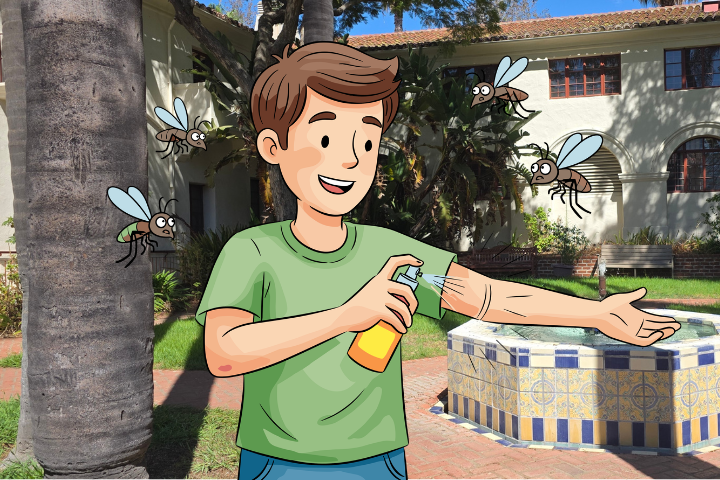
Boy spraying mosquito repellent to keep himself safe from mosquitoes in CI’s Bell Tower Courtyard
Graphic by Dani Ramirez
