
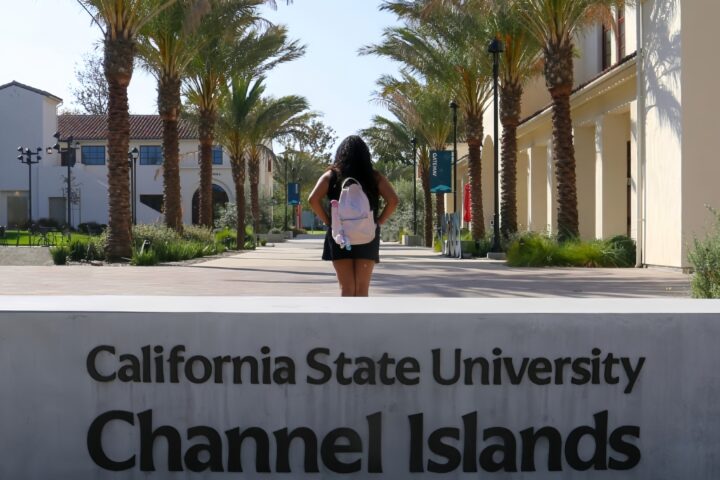
Esmeralda Meckler, a sophomore psychology major, walks on CI’s campus. As the is the first in her family to attend university, she is excited for the journey up ahead.
Photo by Dani Ramirez
By Esmeralda Meckler
Para leer el articulo en español, presiona aquí: https://civiewnews.com/features/estamos-descubriendo-la-experiencia-de-estudiantes-de-primera-generacion-parte-1/
College is often portrayed as an exciting new beginning, but for many students, it can also be intimidating and uncertain. I want to shed light on an experience that is not always talked about: navigating college as a first-generation college student. As someone who has experienced this firsthand, I want others who may be facing similar challenges to know that they are not alone. It is okay to feel scared, frustrated, or different when starting college. These feelings do not make your journey any less meaningful, and your circumstances do not define your ability to succeed.
This article is part of a series exploring the experiences of first-generation college students, with the next two parts featuring interviews with four CI students about their college journeys. I believe it is important to share these stories because being a first-generation college student can sometimes feel isolating. Hearing from others with similar experiences can help students feel understood and more comfortable talking about their own challenges. Through this series, I hope to remind students that they belong in college, even when they are still figuring things out.
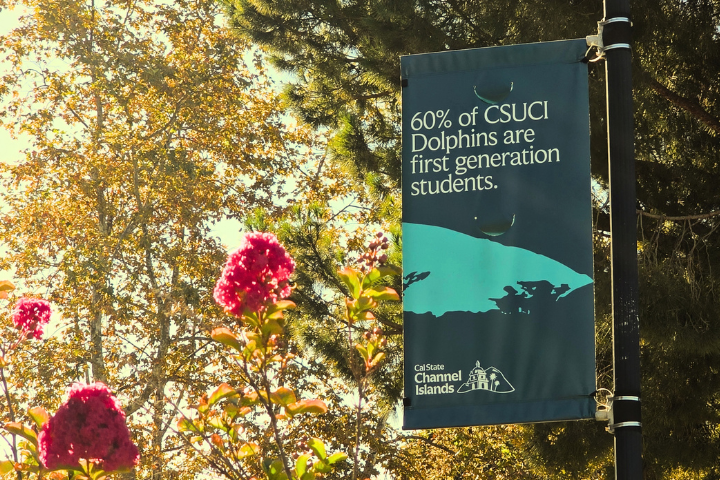
Banner in front of the John Spoor Broome Library on CI’s campus
Photo by Dani Ramirez
My journey
As a Latina in the minority at my high school, I sometimes struggled to relate to my peers. Some lived in nicer neighborhoods and called my neighborhood “poor.” Others had customized cars, while my parents were struggling financially. I also had few opportunities to speak Spanish with my classmates, which made it difficult to strengthen my connection to the language. Although we shared the same classrooms, these differences often left me feeling out of place. When it came time to apply to college, many of my classmates talked about going out of state, moving far from home or attending universities with bigger names. For them, college seemed like an opportunity to leave home and explore somewhere new. For me, it was about figuring out what I could realistically afford.
I remember hearing my peers talk about college funds their parents had created for them or how their families planned to help cover tuition, housing and other expenses. My situation looked very different. I did not have a college fund or financial support waiting for me. Going out of state was something I dreamed about, but financially, it was not an option. I had to choose from the schools I could afford, which ultimately meant staying in California and attending a Cal State. There was nothing wrong with choosing a Cal State. I knew that they still provided the opportunity to pursue a college education and build a future for myself. But in an environment where some of my peers described Cal States as a “last resort,” and for students who aren’t academically strong or couldn’t get accepted anywhere else, it was difficult not to internalize those comments and question my own abilities. I couldn’t afford to move away from home, either. While many of my classmates were preparing to leave their families and start a new chapter somewhere else, I was preparing to continue living with mine. Staying at home wasn’t necessarily a bad thing, but it wasn’t the college experience I had pictured for myself. At times, that made me feel small. It was difficult watching other people experience the college life I had imagined for myself, especially when finances, not academic abilities, were the reason I could not have the same experience. There were moments when I felt jealous, frustrated and embarrassed, even though I knew I had nothing to be ashamed of. I was doing the best I could with the circumstances I had been given.
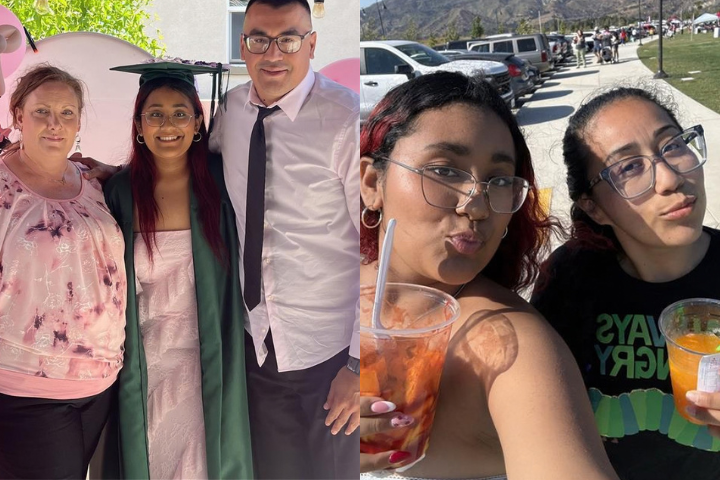
(Left) Esmeralda, with her step-mom and dad, at her high school graduation party
(Right) Esmeralda and her mom at their neighborhood park
Photos courtesy of Esmeralda Meckler
Getting to college was only the beginning of a journey filled with challenges and uncertainty. Once I arrived, I had to learn how to navigate systems I had never encountered before. I didn’t always know which classes to take, who to ask for advice or where to turn when I needed help. My first semester I ended up falling behind on a few of my prerequisites because I did not know what to do or how academic advising worked. I also carried the pressure of wanting to make my parents proud. My mom had me right after high school and sometimes I felt like I was the reason she and my dad could not pursue some of their own dreams. They never made me feel that way, it was my own internal guilt. Therefore, succeeding in college felt more than just a personal goal. I wanted to prove to myself and my family that the sacrifices of pausing their own education and putting aside their career goals along the way were worth it.
My family played an important role in helping me get through those moments. I am especially grateful to my grandma and aunt, who supported me throughout the process, took me in their home and always cheered me on. My best friend, Gray Mallory, and his parents, Lisa and Steve Mallory, also became a huge source of support; they are my second set of parents. They never made me feel like my dreams were too big and always reminded me that I could achieve anything I set my mind to. I know my story is not unique. For some first-generation college students, navigating college can mean managing limited financial resources, less guidance and a lack of family experience with higher education. Knowing that my experience may be common doesn’t always make it feel less lonely, but hearing someone say, “I went through that too.” can make that shared experience feel more real and validate the challenges. Being a first-generation college student is not just about being the first in your family to attend college. It can also mean learning how to navigate an unfamiliar system, making difficult financial decisions and finding confidence in an environment where you sometimes feel like you don’t belong.
Look forward to the Part 2 coming out next Friday, Oct. 9, which include interviews with other first-generation CI students!
The story is just beginning.
