
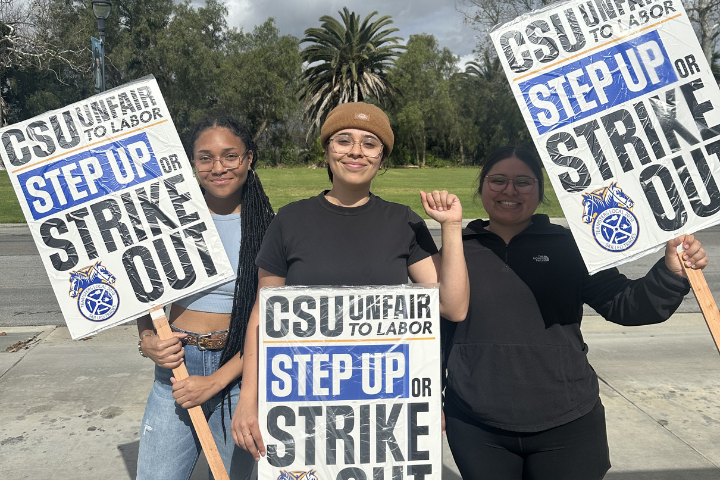
Photo by Madelaine Brown
Pictured right to left: Angelmarie Taylor, senior business major; Mercedes Cacho, junior sociology major; Olanda Lopez-Sweat, junior sociology major.
By Timothy Walker
From administrators and trades workers, to faculty and students, we are operating within a public higher education system increasingly shaped by financial pressures traditionally associated with large institutions. Understanding how and why this structure is producing recurring conflict is essential to understanding the conditions shaping the university today.
Why Teamsters are striking
The Teamsters Local 2010 strike represents trades workers across the California State University system, including electricians, plumbers, HVAC technicians, mail services, and maintenance personnel. These workers are striking over what the union describes as the University’s refusal to honor negotiated step increases and raises that were originally agreed upon in their contract.
According to a January 2026 statement from Teamsters Local 2010 leadership, CSU has delayed or withheld these raises despite prior commitments, offering temporary lump sum payments instead of permanent wage increases. Teamsters officials characterized these actions as bad-faith bargaining and a violation of agreements made with workers. In that same public statement, union leadership declared that workers were “fed up with CSU’s greed, disrespect and unfair practices” and were prepared to strike to secure compensation they believe was already promised. For many workers, the strike is not simply about pay, but about recognition and dignity after years of stagnant wage progression and rising living costs.
CFA support and broader solidarity
The California Faculty Association, which represents more than 29,000 CSU faculty members, has publicly declared its support for the Teamsters Local 2010 strike and encouraged its members to show solidarity. In a January 2026 solidarity statement, CFA urged faculty to honor picket lines and affirmed that it stands in support of Teamsters Local 2010 trades workers and their efforts to secure promised raises and fair treatment. Faculty are legally protected if they choose to participate and are not prohibited from crossing picket lines.
CFA leadership framed its support as part of a shared struggle over labor conditions and institutional priorities and emphasized that trades workers play an essential role in maintaining campus infrastructure. Their labor sustains the daily functioning of CSU campuses. This solidarity reflects a broader pattern of labor tension within the CSU system, where multiple campus worker groups have raised concerns about compensation, working conditions and management decision making in recent years.
CSU administration’s official stance
CSU administration disputes the union’s characterization of the conflict and frames the issue as a matter of contractual funding conditions rather than refusal to honor the agreement. In a January 2026 labor relations update, the CSU Chancellor’s Office stated that Teamsters leadership had publicly claimed the university system received full state funding and should therefore implement negotiated salary increases. However, CSU officials said that interpretation was inaccurate.
According to the Chancellor’s Office, the salary increases outlined in the contract were contingent upon the university receiving approximately $250 million in new, ongoing state funding. Instead, the enacted state budget reduced CSU’s ongoing base funding by $143.8 million. While the state later provided a no interest loan in the same amount to offset the cut, CSU stated that the loan must be repaid and cannot support permanent salary increases. As a result, the university authorized one time lump sum payments rather than ongoing raises and formally requested to reopen salary negotiations under the terms of the agreement.
CSU officials said these actions reflect compliance with the contract’s funding contingency provisions and broader financial constraints facing the public university system.
Executive compensation and spending priorities
Union leaders and faculty organizations have also raised concerns about CSU’s broader spending priorities. According to CFA materials citing CSU financial transparency data, campus presidents earn annual salaries approaching or exceeding $500,000 when housing stipends are included and the CSU Chancellor receives approximately $1 million in total compensation. CFA materials also state that CSU has spent tens of millions of dollars on private consulting firms in recent years, including approximately $74 million to Deloitte, $145 million to Unisys Corporation and $11 million to Huron Consulting. Union and faculty leaders argue these expenditures reflect administrative and consulting priorities continuing alongside delayed wage increases for campus workers.
CSU official financial reports confirm executive compensation levels and consulting expenditures but maintain that these costs serve operational, technological and administrative needs across the 23-campus system.
The conflict itself
The dispute between Teamsters Local 2010 and CSU administration illustrates a broader structural tension inherent in public higher education. Teamsters leadership argues that CSU has refused to honor contractual raises and salary steps that workers had previously secured, framing the strike as a defense of negotiated agreements and fair compensation. Meanwhile, CSU leadership maintains that financial limitations and state funding reductions constrain its ability to implement permanent wage increases, even when those increases were negotiated under different funding expectations. For workers, the issue represents the protection of economic stability and recognition of their labor. For administrators, the same issue represents a financial commitment that could affect long-term budget flexibility and operational sustainability.
Student impact and material reality
As a residential advisor, I have seen how postponed maintenance and delayed supplies affect student programming and daily planning. As a student awaiting packages and relying on campus services, I have experienced these disruptions directly. As a student journalist observing these events unfold, I have watched how decisions made at the institutional level translate into immediate changes in campus life.
The effects of the strike are already visible on campus. In student housing, only emergency maintenance requests are currently being prioritized and mail services have been disrupted, delaying the delivery of packages for residents. On the first day of the strike, picket lines formed at campus entrances, distributing flyers and interrupting the normal flow of campus operations.
The stability of campus life depends on agreements and conditions that often remain invisible until they begin to break down.
