
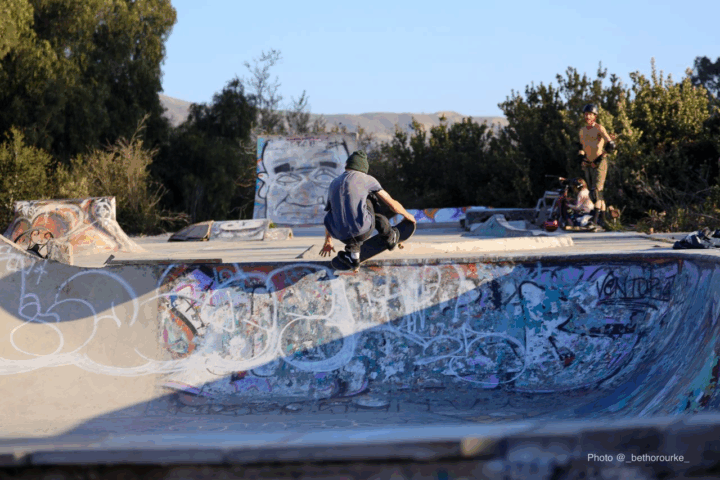
Unknown Skaters at Zeke’s DIY Skatepark
Photo provided by Beth O’Rourke
Written by Hali’a Hibbitt
Just off of Highway 33, before Ojai, California, a gem was nestled into the foothills of Ventura, California: Zeke’s Do It Yourself (DIY) skatepark. Built on an abandoned platform in the Ventura Oil Field, this mish-mashed skatepark has been a community hub since its founding during the Covid-19 pandemic. Zeke’s was no stranger to birthday bashes, family BBQ’s, and professional skate edits: see Powell Peralta “Zeke’s DIY” on YouTube. The feeling was that this spot was only in the beginning of what it could have been for the skate community at large, and the local Ventura skate community before its untimely demolition. While Zeke’s was built illegally, Beth O’Rourke, a celebrated surfer, photographer, creative director, filmmaker, and proud to call Ventura home for the last decade, says that that is part of the beauty of a DIY skatepark. When I asked O’Rourke to explain what a DIY spot is to our unfamiliar readers, her words brought back the pain of when my home town lost our DIY spot a few years back: “A DIY spot is an iconic symbol of any community. It’s built by the hands of the people in the community that have a dream, that there is a perfect skate park and they have the power to build that within their community.” She went on to say that a DIY “enriches people’s lives” and is “the most genuine form of expression of a community, and their love and to show love to their community,” all the while half-jokingly referring to Zeke’s as “Shangri-La.”
The park’s longevity was always in question. That is the name of the game with DIY spots, and it was enjoyed fully until its last day. In July 2022 the community was told that the foothills that the park was located on were purchased for $4 million by The Ventura Land Trust, back in 2020. The area was formerly known as the Mariano Preserve, and has since been renamed to the Ventura Hills Nature Preserve. The neighboring 2,123 acre Harmon Canyon Preserve was also acquired by the Ventura Land Trust in 2020. According to the Ventura Land Trust website, the 1,645 acres of the Ventura Hills Preserve are planned to be ecological restoration sites to support the recovery of the area’s endangered flora and serve as a passageway to open spaces that are vital for wildlife. Upon its opening in late 2025, The Ventura Hills Nature Preserve will be free and open to the public for biking and hiking on the new trails. In addition to these two preserves, the Ventura Land Trust also owns and stewards five other preserves in Ventura county. This totals up to 3,876 acres of land across the seven preserves. The Ventura Land Trust has a vision for what these open spaces can be for the community. According to their website, The Ventura Land Trust’s mission “is to permanently protect the land, water, wildlife and scenic beauty of the Ventura region for current and future generations.” The non-profit goes on to share their “transformative vision,” beginning with “Ventura Land Trust (VLT), a community-based nonprofit organization, believes that preserving open space and providing responsible public access enhances the economy, quality of life, and public well-being of Ventura and surrounding communities. With local partners, VLT works to protect the natural beauty of our area.” Where O’Rourke and many others get stumped, is what is the difference between the Ventura Land Trust’s transformative vision and the skate community’s vision with Zeke’s?
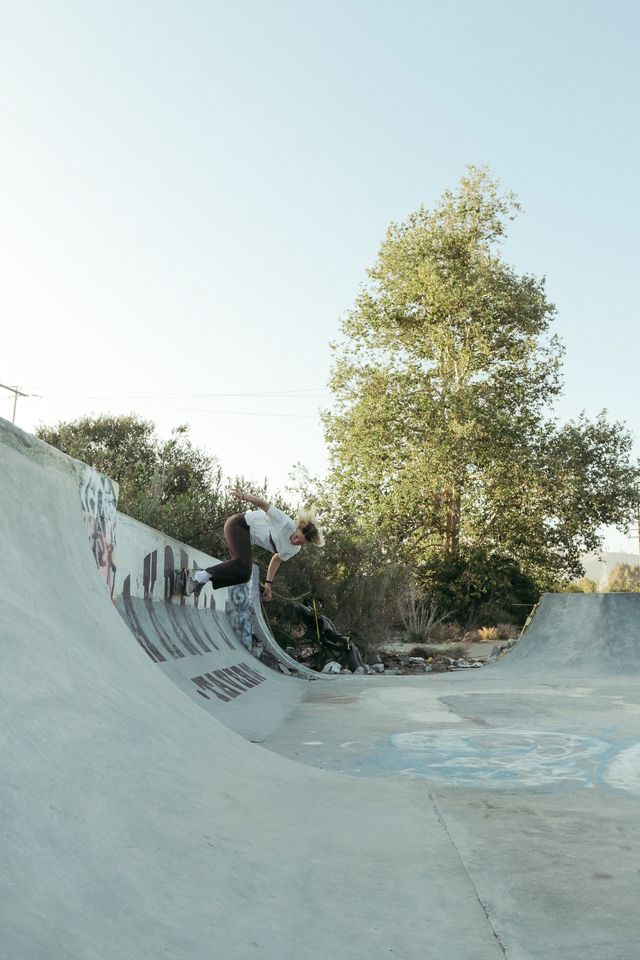
Ally Heady skating at Zeke’s DIY Skatepark
Photo provided by Beth O’Rourke
O’Rourke lamented, “It’s just fascinating to me that this park, that its destiny was determined by people that have little or nothing to do with the park, but share the same mission and visions for the land.” She then goes on to tell me stories of families enjoying the park, kids falling in love with skateboarding outside, and whole-heartedly sharing that “DIY is a family affair. Even your chosen family.”
To those that may not see the need of these unofficial community built and run spaces, O’Rourke said “(Zeke’s) has all the hallmarks of all these structured organizations and non-profits also claim to stand for,” and would have been happy to work with the Ventura Land Trust to come to an agreement to keep the park. Part of why Zeke’s was so special was because of its secluded location in nature. Having a skatepark, which are typically in urban areas, in an open space was a unique treasure to the community. Reflecting on her images taken at the park over the years, O’Rourke said, “I intentionally wove the surrounding natural beauty into my skate images. The park was hidden from plain view, buried behind a tall and deep stand of trees and shrubs. Much of the park was surrounded by tall native plants that spilled into it, adding an earthy softness to the park’s built shapes. To me, the DIY was just another thriving native, hidden from plain sight in an idyllic valley carved out by the Ventura River, nestled into the Ojai mountain foothills. The intricate poetry of nature was hardly disrupted. This native ecosystem was a natural community of plants, animals, and microorganisms that developed in a specific geographical area over a long period of time and are interconnected.” The way she described the park evokes the idea that Zeke’s, as much as the flora and fauna, all belonged on the shared land. As O’Rouke said, “beauty is in the eye of the beholder” and Zeke’s was certainly held close to heart.
As bulldozers and security strolled up to the park, skaters scrambled to save relics. Some skaters have said Patagonia donated money to The Ventura Land Trust and was to blame for the demolition. Others have said The Ventura Land Trust was solely to blame. While the “who” is certainly a large question, there is still confusion about why Zeke’s had to be demolished. As O’Rourke put it frankly, “it’s their land,” thoughtfully followed by, “but just because you can doesn’t mean you should.” Either way, it was a loss to the community. I asked O’Rourke what she wished the Ventura Land Trust had done and we got to talking about how a community operates: “A community works in good faith. That’s the currency. What I hope is that The Ventura Land Trust holds out the hand of communication to us (skaters) as a group.” Despite the loss of Shangri-La, O’Rourke is certain that the skate community is still here, and here to stay for generations, but will sorely miss the “bright vibrant colors that formed a tapestry” that was the Zeke’s community.
Through discussions and research about Zeke’s, Ventura land ownership, Patagonia’s monetary donations to the Ventura Land Trust, and many hours on Ventura counties geographic information system maps, it raised a question for me: Who does and why do they get to decide what our public spaces are? As a skater and environmental studies student, I can see both sides of the argument. However, what O’Rourke and I both know is that we need to involve and include the voices of the entire community as we change and build it. Skateparks, trails, and libraries alike, all deserve their proper space in each and every community. Rest in peace Zeke’s.
Photos for this article were provided by Beth O’Rourke, @_bethorourke_
